Beneath the ocean’s surface lies one of the most amazing ecosystems on Earth, coral reefs. Often called the “rainforests of the sea,” these underwater worlds are filled with life, color, and complexity. But today, they face the quiet and growing threat of ocean acidification.
As humans release more carbon dioxide (CO₂) into the atmosphere, a significant portion of it is absorbed by the ocean. This might sound like a good thing. That the ocean absorbing the CO₂ slows climate change in the air, but it actually comes at a large cost. When CO₂ dissolves in seawater, it forms carbonic acid, lowering the ocean’s pH. This process, known as ocean acidification, is fundamentally changing the chemistry of marine environments.
Corals, like those that build the massive structures of the Great Barrier Reef, rely on calcium carbonate to construct their skeletons. But as ocean acidity increases, carbonate ions which are the building blocks corals need, become less available. Without enough of these ions, corals struggle to grow and maintain their structures. In extreme cases, their skeletons can even begin to dissolve.
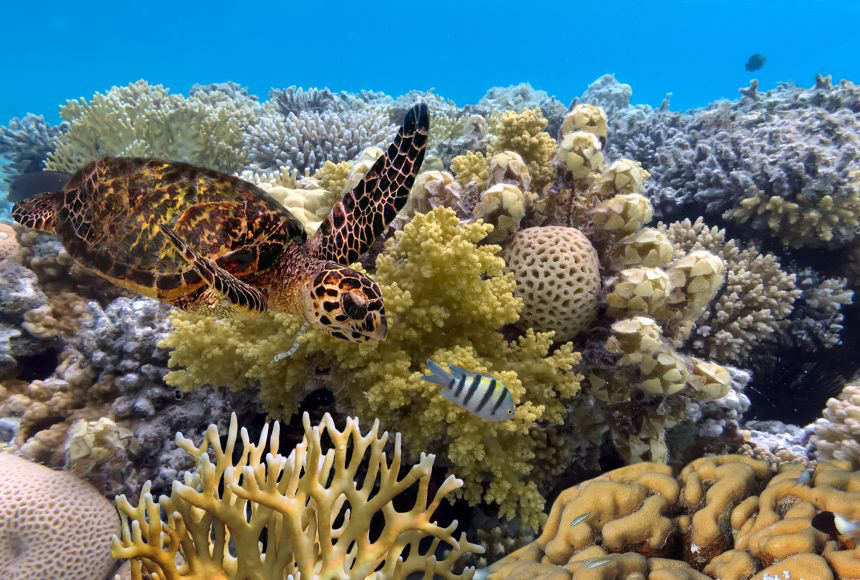
Coral reefs like the Great Barrier Reef off the coast of Queensland, Australia, support diverse marine populations in unique underwater ecosystems. Photo by VLAD61
This isn’t just a problem for corals themselves. Reefs provide habitat, food, and protection for countless marine species, from fish to invertebrates. When coral growth slows or reefs begin to erode, entire ecosystems are put at risk. The loss of coral reefs also impacts humans. Millions of people depend on them for food, coastal protection, and income from tourism.
Ocean acidification doesn’t act alone. It often works alongside warming ocean temperatures, which can lead to coral bleaching. During bleaching events, corals expel the symbiotic algae that live within their tissues, losing both their color and a major source of energy. When combined with acidification, the stress becomes even more difficult for corals to handle.
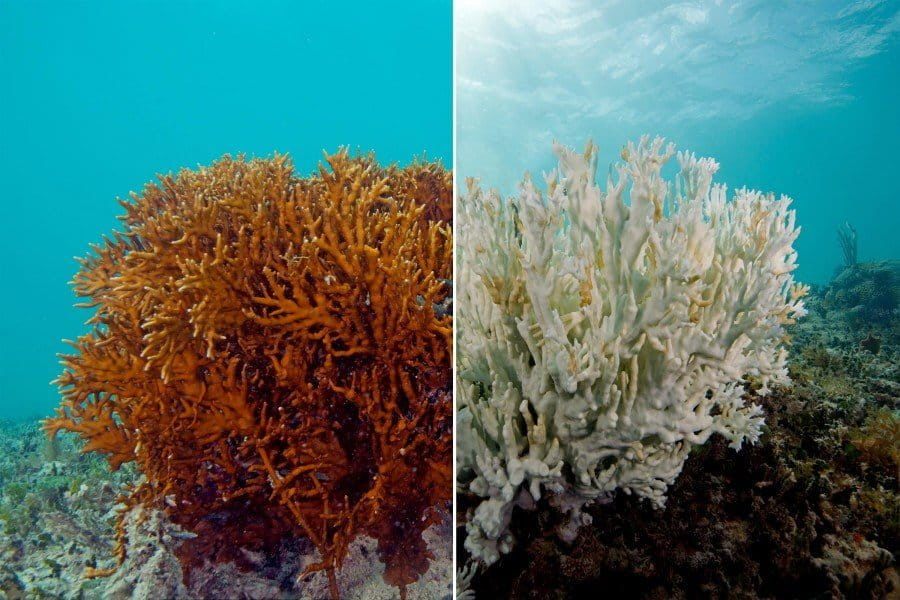
A fire coral before and after bleaching. The one on the left is a healthy fire coral, while the one on the right is completely bleached. Photo by the XL Catlin Seaview Survey.
Despite the gravity of the issue, there is still hope. Scientists are studying more resilient coral species and exploring ways to support reef recovery. Efforts to reduce carbon emissions globally are critical, as they address the root cause of acidification. Locally, protecting reefs from pollution and overfishing can also improve their chances of survival.
Ocean acidification may be invisible to the naked eye and an abstract problem, but its effects are anything but. As the chemistry of the sea shifts, the future of coral reefs hangs in the balance. Protecting them means not only preserving their beauty, but also safeguarding the complex web of life they support and the human communities that depend on them.