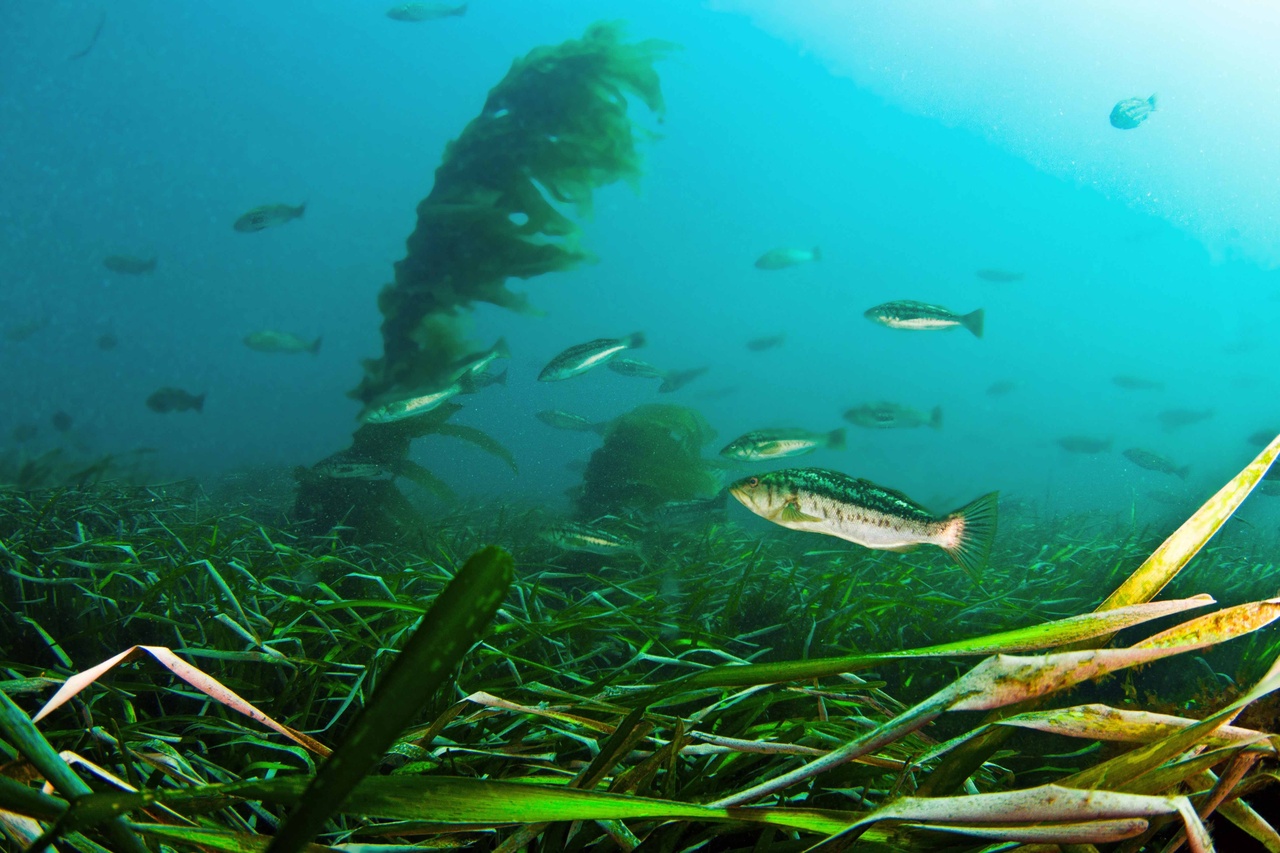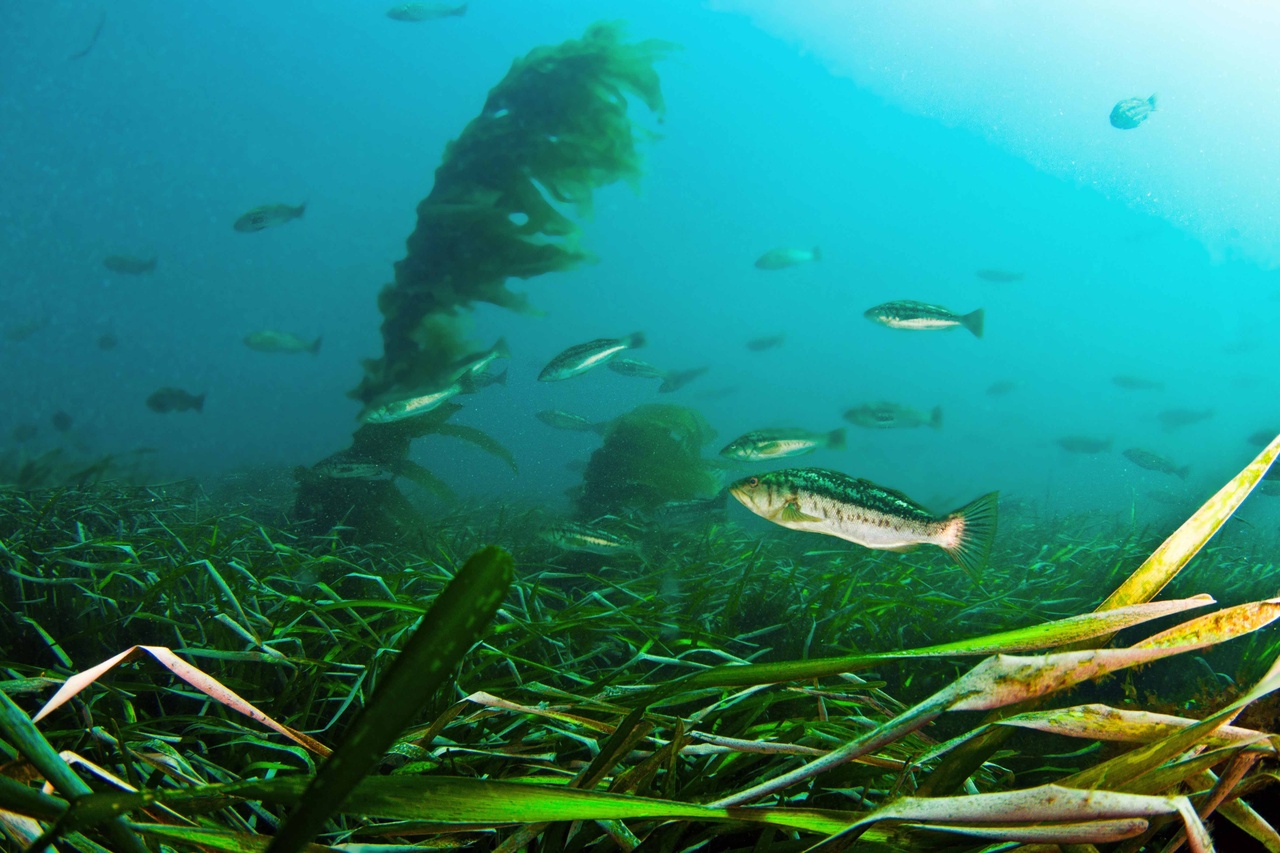
Eelgrass (Zostera marina) is one of two seagrass species that grow in shallow (up to ~30 ft), calm waters of the North Atlantic. Unlike seaweed, eelgrass is a true flowering plant with roots, rhizomes, and blades that anchor it into sandy and muddy sediments in intertidal and shallow subtidal zones. It forms dense underwater meadows that are among the most productive and ecologically important habitats along temperate coastlines. These meadows occur in estuaries, bays, and protected coastal embayment’s where light can reach the bottom and salinity remains within a suitable range.
It is an incredibly important habitat for numerous species across several phyla (seaweed, invertebrates, fish) that utilize the support structures of eelgrass for breeding, reproduction, and as a vital part of migration. Juvenile fish, scallops, crabs, shrimp, and many other invertebrates rely on eelgrass beds as nursery grounds. The vertical blades slow water movement, trap sediments, and create a three-dimensional structure that lowers predation rates compared to unvegetated mud flats. Migratory waterfowl also depend on eelgrass, feeding directly on its shoots and roots. Because eelgrass stabilizes sediments with its root systems, it reduces coastal erosion and improves water clarity by trapping suspended particles. There are no substitute structuring organisms with the same function as eelgrass that can grow on the sand-mud flats of intertidal and subtidal areas within the salinity ranges occupied by eelgrass. In the absence of eelgrass, these areas would be sandy mud flats that harbor no protection from the elements and are highly susceptible to erosion and displacement by storms.
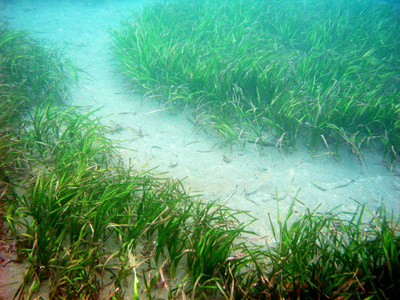
NPS. Credit: NPS
Since 2006, when the requirements were created and agreed upon, eelgrass has met the criteria of an ecologically significant species. If the species were to be severely perturbed, the ecological consequences would be substantially greater than an equal perturbation of most other species associated with this community. Eelgrass also plays a major role in carbon sequestration, often referred to as “blue carbon.” By capturing carbon dioxide through photosynthesis and storing it in sediments, eelgrass meadows help mitigate climate change on a local and global scale.
As important as eelgrass is, it is also very vulnerable to pollution, nutrient loading, dredging, coastal development, and warming waters. Disease events in the 1930s caused massive die-offs, and recovery in some regions has been slow. Today, with many eelgrass habitats degraded, nearly 30% of global seagrass habitat has vanished since the 1800s alone. Since eelgrass constructs the physical habitat of many sea creatures, when outside factors impact the health and growth of eelgrass, the coastal ecosystem as a whole is affected. Being interconnected in the food web, many species rely on eelgrass beds and meadows not only for food, but for shelter as well. When these meadows disappear, so does wildlife.