Communication is vital for survival; it allows us to express our needs, wants, and form communities with each other. More importantly, it allows teamwork to reach common goals such as innovation and overcoming obstacles. We often think of communication when it comes to humans, however there are so many other species that incorporate the skill into their livelihood. One of the most prevalent ones is whale communication.
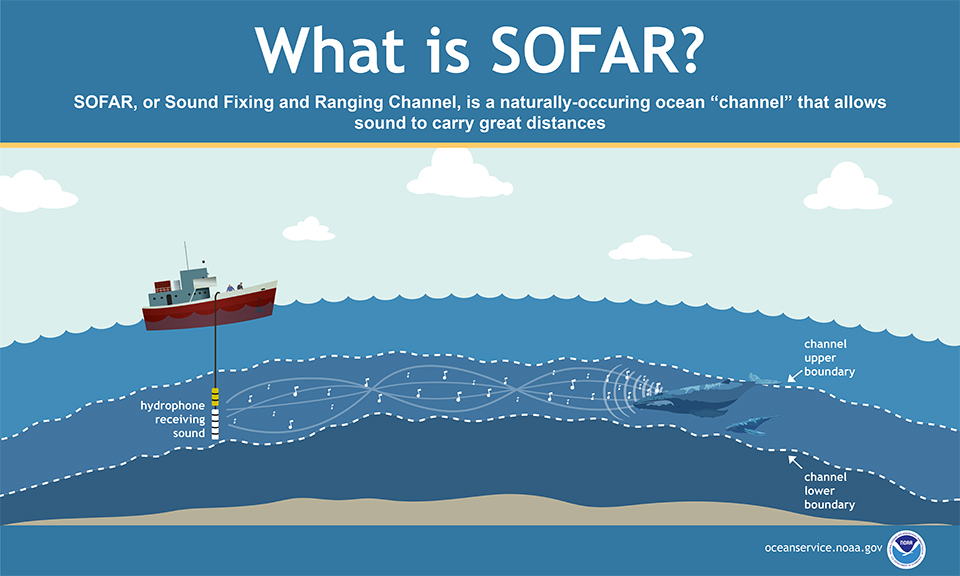
There are two suborders of whales that influence the way they communicate; baleen and toothed whales. Baleen whales are filter-feeding organisms, and instead of teeth they have hundreds of baleen plates made out of keratin – the same material in human hair and nails. This group of whales includes but is not limited to Blue whales, Humpback whales, and North Atlantic right whales. To communicate, baleen whales can enhance how far their sound is traveled by singing to each other in low rumblings and low growls, faint to the human ear; they can even travel their sound up to thousands of kilometers. Having these low frequency calls ensures less scattering, distortion, and transmission loss. Furthermore, baleen whales often make their calls in the deep sound channel, also known as the SOFAR channel, located 1000 meters deep in the ocean. Communicating in this channel increases sound speed and reduces transmission loss. Comparatively, at the surface the waves can dissipate the whale’s call. Not only can baleen whales use the SOFAR channel for communication, but they can use it for navigation by listening to their calls echo off distinct ocean shelves and coastlines, a process known as echolocation.
One example of baleen whale communication are Humpback whales, known for their beautifully complex songs. While their songs were discovered in the 1950s, it wasn’t until 1971 where biologists Roger Payne and Scott McVay recognized through a spectrograph, a visual representation of the whale sounds, that their songs are made up of structured repeated patterns. The Humpback whale would create a theme of different pitches and volumes, repeat it, and then create a new theme. After the Humpback whale was done creating new themes, it would cycle back to the first theme and create a second rendition; creating a song. When the whale was done with their theme or song they would return to the surface to inhale, and then sink back down again to continue their calls, quickly tucking their breaths in between the notes to not interrupt the performance of the song. For reference, the structure of their call could look like this: AAABBBBCCCCDDDEFFF, with each letter indicating a different theme and the number of the same letter indicating how often that theme was repeated before moving to the next. With these songs, Humpback whales could sing for a period of 7 minutes to hours, never repeating a previous theme pattern.
Compared to the baleen whales low frequency calls, toothed whales use high-frequency clicks and whistles. Toothed whales, as the name suggests, have teeth inside their jaws and use their teeth to catch prey. This group of whales includes Sperm whales, Beluga whales, and several dolphin species among many others. Similar to baleen whales, toothed whales use echolocation for navigation and communication. To create noises, toothed whales blow air through their phonic lips, a vibrating tissue located along their nasal passage beneath their blowhole. Additionally, in order to create their clicking sounds, whales release short blasts of air in their nasal passages and across their phonic lips, which causes them to slap together.
An example of toothed whale communication are Sperm whales, known to be one of the loudest living creatures on Earth. These whales communicate through codas, a sequence of clicks and pauses that can last up to an hour. It’s even thought that these codas carry information similar to how Morse code functions. For instance, sometimes the tempo, length, and number of clicks vary in a coda. Not only can these values differ, researchers that have dedicated their career towards listening to Sperm whale calls have discovered that different Sperm whale populations have their own “dialect” of coda click-patterns; as they learn their click patterns from other members of their clan rather than genetic inheritance.
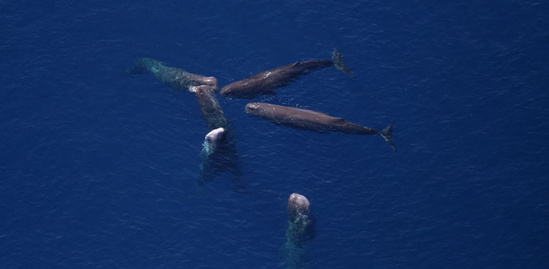
While there is still much unknown about whale communication, modern technology is currently bridging this gap. There are several different organizations incorporating artificial intelligence to produce rapid analysis of whale recordings by discerning the different signals, patterns, and potential meanings behind it all. One program specifically focused on Sperm whale calls is Project CETI, short for Cetacean Translation Initiative. In the program, Sperm whales are first monitored and recorded of their movements and sounds through aerial drones, swimming robots, small high-tech suction-cup attached computers, and hundreds of synced understater microphones. The data collected is then processed through computers and artificial intelligence where it searches for patterns in the language. Lastly, any understanding of the communication will be ran through sperm whale chatbots to test their language models.
Undoubtedly, sound is a huge aspect of whale life and how they communicate with each other. There’s still much to learn when it comes to the science behind their behaviors. Yet with modern technology it opens the window in understanding whales among many other animals. As Jane Goodall once said in response to technological advances in animal communication, “Ever since I was a child, I’ve dreamed of understanding what animals are saying. How wonderful that may now be a real possibility”.
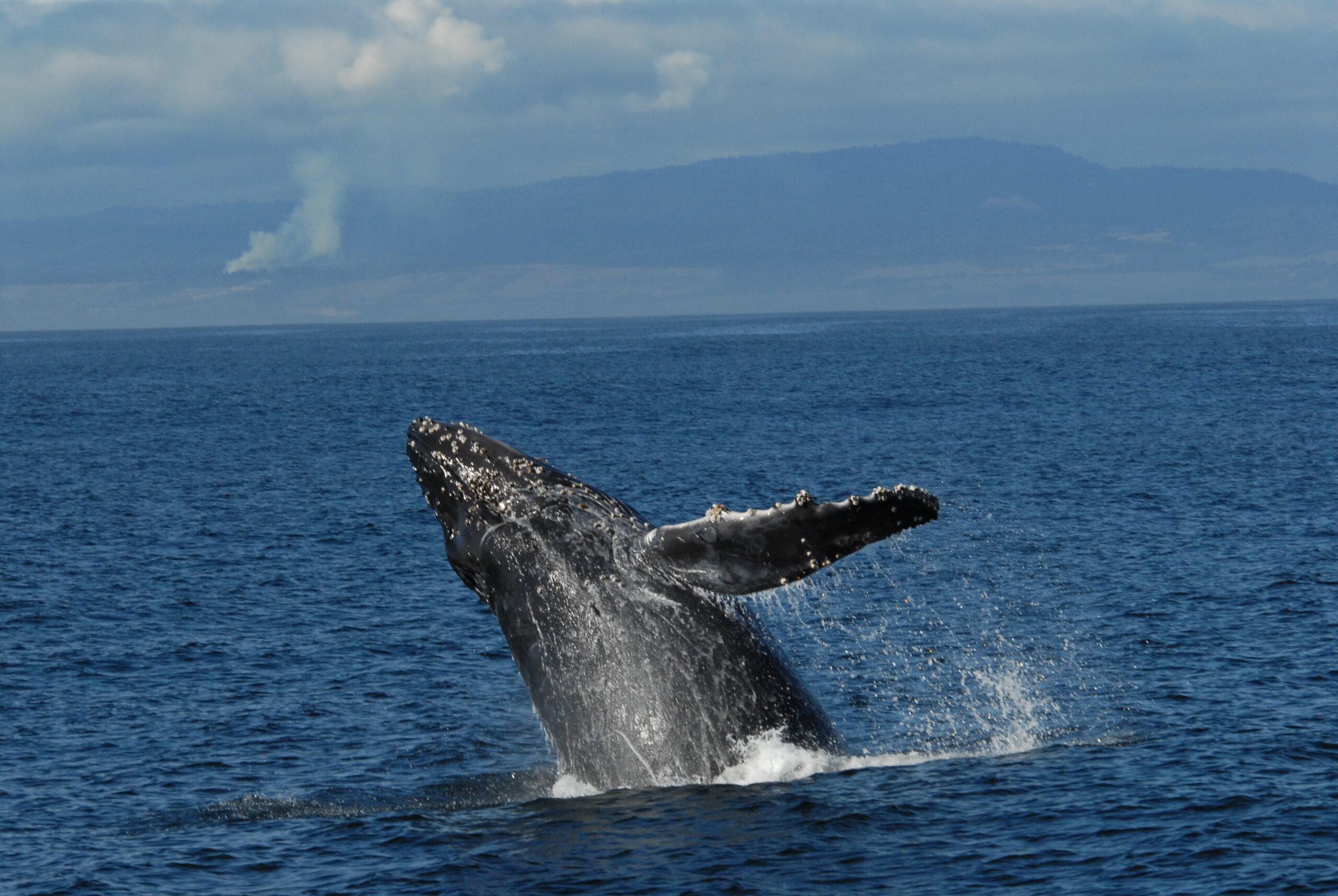
Feature image: Photo taken by Dr. Mridula Srinivasan of a Humpback whale breaching out of the water in California, Monterey Bay (Image from NOAA)