When most people think of sharks, they imagine strong, powerful swimmers cutting through the open ocean. Sharks such as great whites and tiger sharks certainly fit that description. However, living in the coral reefs of the Indo-Pacific region is a species of shark that completely flips that expectation: the white-spotted bamboo shark.
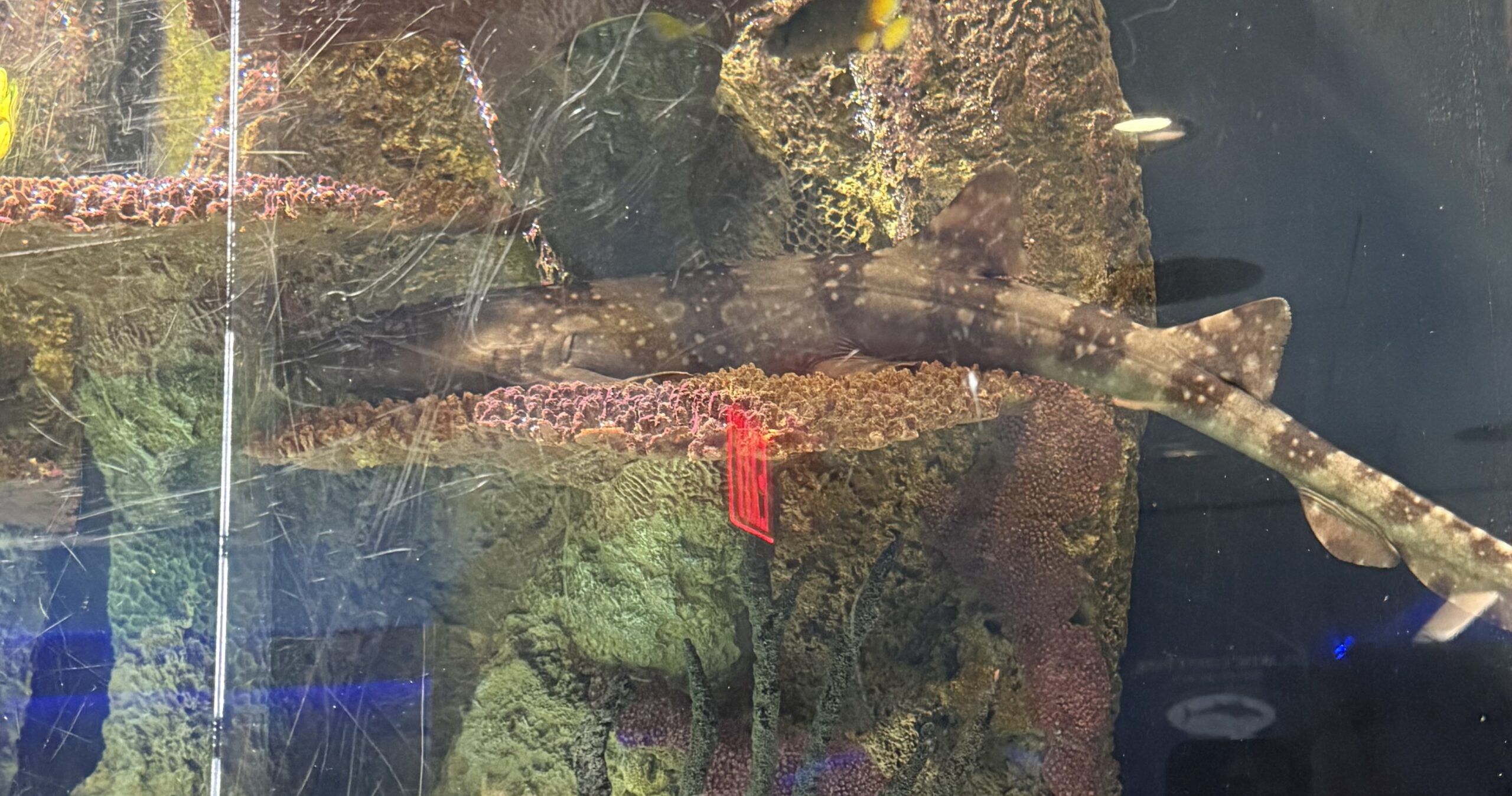
The white-spotted bamboo shark (Chiloscyllium plagiosum) is sometimes called a “walking shark.” As its nickname suggests, this species is different from many other sharks because, instead of only on swimming, it can also move along the seafloor in a walking-like motion. But how does a shark “walk”? They do not have feet. The white-spotted bamboo shark uses its fins to push itself forward across the ocean floor. One fin pushes forward while the other stabilizes the body, creating a slow, stepping motion. This movement is not a true walk like a land animal, but it closely resembles crawling. Although they are capable of swimming, this bottom-based movement is especially useful in their environment.
Their form of movement is especially effective in the habitat they live in. White-spotted bamboo sharks are measured to be about 3-5 feet in length and live in shallow coral reefs in the Indo-Pacific region. This includes the Indian and Pacific ocean and countries such as Indonesia and the Philippines. Living in shallow waters means that space is limited. By moving along the bottom, they can slip into narrow crevices, being able to navigate and thrive in complex coral structures, and quietly approach small prey without needing open water speed.

They are carnivorous, with their diet consisting of small fish, crustaceans, and other bottom-dwelling organisms. Their slow, walking movement allows them to search the seafloor with precision, looking through the cracks and crevices where their small prey could be hiding. Instead of chasing fast-moving animals, they carefully move through their habitat, using their specialized form of movement to find food where other sharks could never reach.
This type of locomotion is also seen in closely related species such as the epaulette shark (Hemiscyllium ocellatum), which is well known for its ability to “walk” between tide pools and tolerate low-oxygen (hypoxic) conditions. While the white-spotted bamboo shark is still capable of swimming continues to do so, it not as extreme in this behavior as epaulette sharks. These adaptations highlight how some reef-associated sharks have evolved to survive in environments where traditional swimming is not always the most effective strategy.
The white-spotted bamboo shark is a reminder that sharks are not all defined by speed and power. Instead, this species represents a more specialized and adaptable form of survival. Its movement is not about dominating the open ocean, but about thriving in a specific ecological niche. This shows how diverse and specialized life in the ocean can be, even within a group as often stereotyped as sharks.