https://phys.org/news/2019-12-million-year-old-fossils-reveal-sea-lilies.html
Sea lilies are some of the strangest animals in the ocean. Although they resemble delicate underwater plants, they are actually marine invertebrates in the class Crinoidea, within the phylum Echinodermata (starfish and sea urchins). Most modern species live in the deep sea, where they stand the test of time as living remnants of prehistoric marine ecosystems.
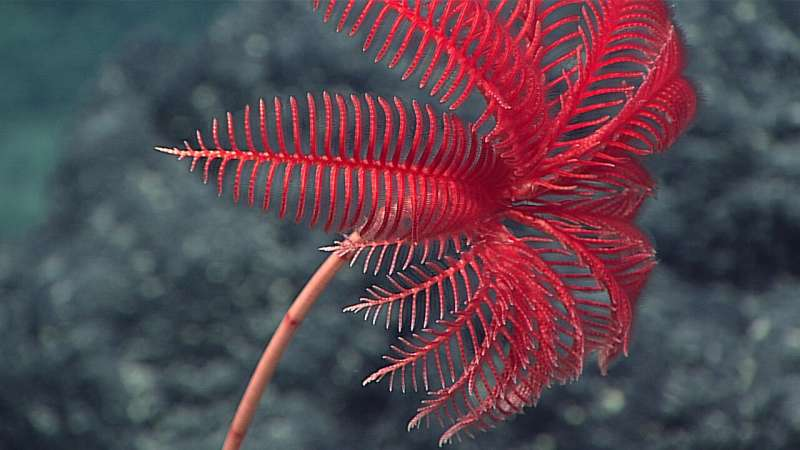
Sea lilies have a similar body plan, although they can vary wildly in coloration and size. A long, flexible peduncle, or stalk, looks almost like the trunk of a palm tree, and is used to gain elevation off the seafloor for feeding. Attached to the stalk is the calyx, which houses the main body, and extending from it are numerous feathery arms lined with smaller branch-like structures called pinnules. These arms give sea lilies their flower-like appearance, but they are highly specialized feeding appendages rather than decorative features. At the “bottom” of their bodies, they have multiple rows of cirri, or a sort of holdfast, used to anchor onto the hard substrate.
https://learningzone.oumnh.ox.ac.uk/echinoderms
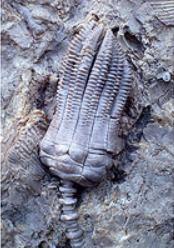
These crinoids have existed for over 400 million years, with fossil records dating back to the Paleozoic Era. During this time, crinoids were extraordinarily abundant, forming dense forest-like patches across shallow seas. Fossilized fragments of their calcium carbonate skeletons are so common that they contribute significantly to certain limestone formations, often in the continental U.S. The basic morphology of sea lilies has changed very little since early fossil records, demonstrating the long-term success of their evolutionary design.
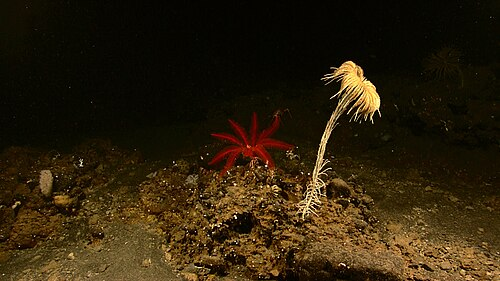
Today, most sea lilies are found at bathyal and abyssal depths, typically ranging from a few hundred to several thousand meters below the surface. These environments are characterized by low temperatures, high pressure, and complete darkness. Sea lilies rely heavily on benthic boundary currents, which deliver a steady supply of suspended organic matter. As suspension feeders, they extend their arms into the current to capture zooplankton, detritus, and other particulate organic material. Tiny, mucus-coated tube feet (part of the echinoderm vascular system) trap food particles and transport them along ambulacral grooves toward the mouth.
https://en.wikipedia.org/wiki/Crinoid#/media/File:Crinoid_and_comatule.jpg

Despite being sessile for most of their lives, sea lilies are not entirely immobile. They can exhibit limited movement by flexing their stalks or adjusting their calyxes with the current to optimize feeding efficiency. Some species are capable of autotomy, where they sever a few segments off, usually near their cirri to escape from a predator. In other cases, they can voluntarily let go of the substrate if need be, usually to find a better place to feed, or escape from, certain environmental conditions.
Ecologically, sea lilies contribute to nutrient cycling in deep-sea ecosystems and provide microhabitats for smaller organisms that inhabit their feathery arms. They also serve as prey for certain benthic predators. Beyond their ecological role, they are of significant scientific interest, helping researchers understand echinoderm evolution, paleoecology, and adaptation to extreme marine environments.
Sea lilies are elegant, slow-moving animals that have braved the test of time, showing their survivability over many millions of years. Anchored to the ocean floor and feeding from passing currents, they embody both the stability and resilience of life in the deep sea.