Bioluminescence is one of nature’s most fascinating phenomena, but for many organisms, it’s a crucial adaptation for survival. Bioluminescence can camouflage organisms, lure in prey, and assist in escape from predators. Many marine animals living in the deep ocean rely on bioluminescence because sunlight doesn’t penetrate those depths. As a result, these organisms have evolved light-producing structures and behaviors that help them survive in a dark and competitive environment.

Bioluminescence is an important adaptation for many deep-sea fish, including hatchetfish, which use a technique called counter illumination to avoid predators. In the open ocean, there are very few hiding places, so fish swimming above predators can easily be seen by their shadows, showing their silhouette, making them stand out and become easy targets. Counter illumination helps solve this problem by allowing the hatchetfish to produce light from special organs called photophores on the underside of their body. These organs create a light that closely matches the intensity and color of the surrounding water, canceling out the fish’s shadow. Because of this, predators looking upward have a much harder time telling the fish apart from the background light, giving the hatchetfish a much better chance at survival.
Angler fish also use bioluminescence, but for a different purpose. They live in the midnight zone, where sunlight cannot reach. To survive in this darkness, female angler fish use bioluminescence to lure in prey while keeping the rest of their bodies hidden from both prey and predators. They have a long spine extending from the top of their head, and at its tip is a sac called an esca that contains bioluminescent bacteria. The spine and its esca dangle in front of the anglerfish’s mouth emitting light that travels clearly through the water, while the rest of its body remains still. To make this adaptation even more effective, anglerfish have ultra-black skin that absorbs almost all light, making the glowing esca its only visible feature. Together, these adaptations allow anglerfish to capture prey without being detected, while also conserving energy.
.jpg)
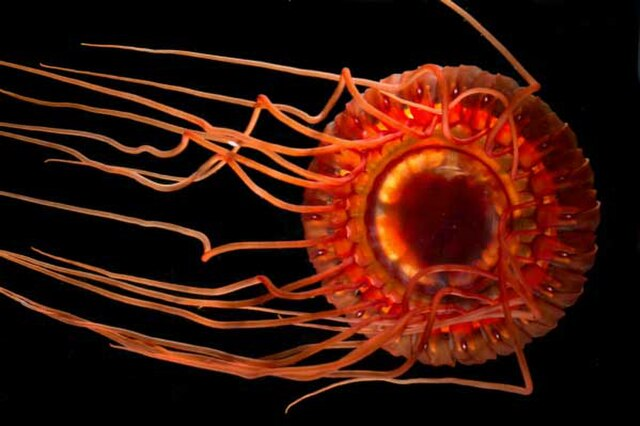
Another function of bioluminescence is escaping from predators, as seen through the Atolla jellyfish. When the jellyfish is attacked, it produces bioluminescence through a chemical reaction where luciferins are oxidized with the help of the enzyme luciferase. This process creates a bright flash of blue light that lights up the surrounding water. The sudden burst of light can startle the attacking predator, disrupting its attack. In addition, this flash acts as an alarm attracting larger predators to the scene, which may target the attacker instead. This distraction gives the jellyfish the opportunity to escape.
Bioluminescence plays a crucial role in the survival of many deep sea organisms, allowing them to adapt to one of the harshest environments on Earth. Whether it’s used to hide from predators, lure in prey, or escape attacks, this ability provides a significant advantage in the dark ocean. From the counter illumination of hatchetfish to the glowing lure of anglerfish and the defensive flashes of Atolla jellyfish, bioluminescence shows the variety of survival strategies underwater.