The humpback whale (Megaptera novaeangliae) is one of the most notable of the baleen whales known for its complex behaviors including breaching, long-distance migration, and their beautiful songs. The name Megaptera means “big-winged” referring to their large pectoral fins while novaeangliae means “New England” for where they were first discovered by European whalers. Humpback whales travel great distances across the world’s oceans as they have one of the longest migrations of any mammal. They travel between high-latitude, cold feeding grounds to warm tropical breeding grounds, up to 5,000 miles. In these productive feeding grounds, they consume krill and small fish, utilizing their baleen plates which filter large amounts of sea water.
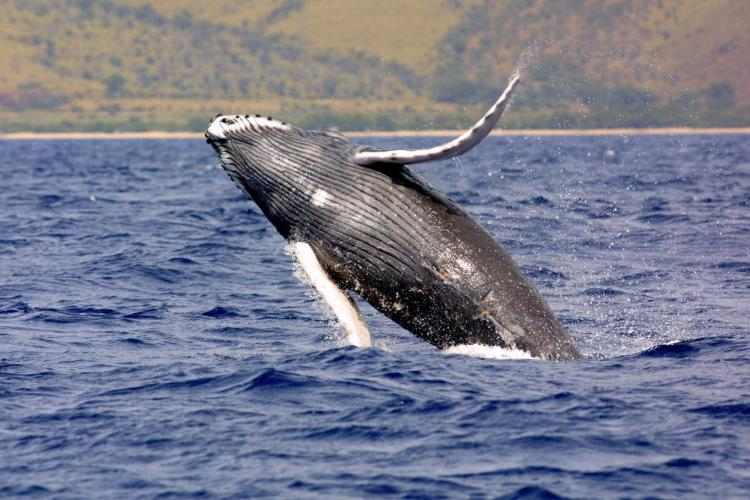
One distinctive trait about humpback whales is their ability to communicate through sound waves. Most commonly used by males, these vocalizations, or “songs” are often associated with attracting females. Just like how they migrate from their feeding grounds to breeding grounds, humpback males will sing along migratory paths, however, it is most prominent when they reach the breeding grounds. Similar to our songs, these series of sounds are composed of multiple themes that take humpback whales 10 to 15 minutes to sing before starting over. Each theme is distinguishable through different repeated patterns that other whales can detect and respond to.
Although whales are large in size and inhabit many of the world’s oceans, they remain vulnerable to human activity which continues to grow as human presence and industry increases. Humpback whales, like any other whale, face dangers from fishing gear, vessel strikes, vessel harassment, and noise pollution in the ocean. Humpback whales rely on their ability to produce complex songs as a way to communicate across vast distances, but the growing noise pollution poses a serious threat.
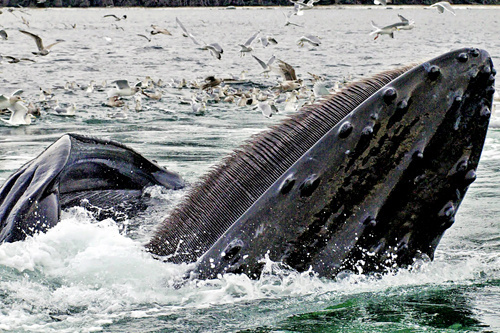
Seismic airgun blasting is one of the most harmful activities happening today due to the oil and gas industries. Seismic airgun blasting is a technique used to map underground rock layers in hopes to find where oil deposits reside. They do this by emitting large, noisy, air blasts into the seabeds of the ocean which then get relayed back to sensors on the surface. This intense repetition of blasts masks humpback whale vocalizations, seeing as the sound can cover 115,000 square miles of the ocean floor, preventing them from hearing each other, causing stress and discomfort.
These disturbances are not limited to whales, but extend to other marine organisms and even fisheries. After experiencing these air blasts, fish are driven away from their home ranges, which lowers catching rates for fisheries and impacts communities that rely on these fisheries. Although marine organisms like fish are able to swim away, some do not have the ability to move fast enough, for example, benthic organisms like scallops and lobsters. These bottom dwellers become injured which decreases their feeding and ability to reproduce.
In conclusion, their ability to communicate is key in ensuring reproduction and navigation across their vast ocean habitat. These vocalizations are experiencing increased disruption by noise pollution, specifically seismic air blasts caused by humans which has numerous impacts on humpback whale behavior.