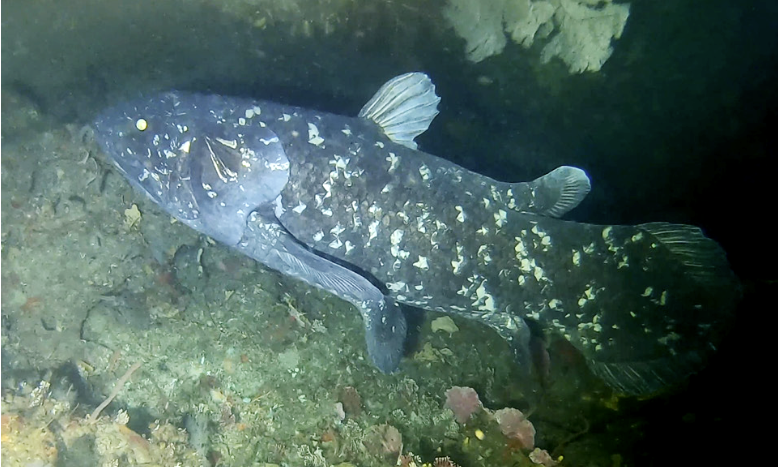
Most, if not all, of us have asked the question: what if dinosaurs were still alive? While a coelacanth isn’t exactly a dinosaur, it is one of the longest-living species known on Earth—and one of the closest things we have to a “living fossil.”
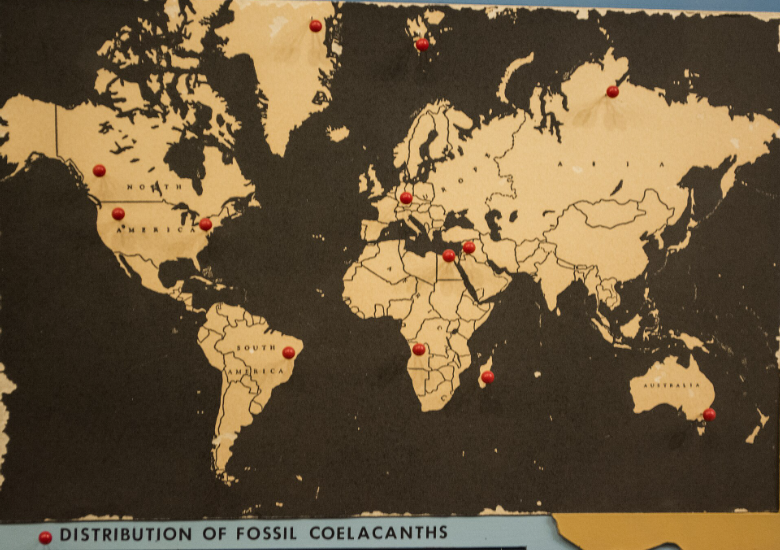
Coelacanths were first identified in the fossil record by Louis Agassiz in 1836, when he described a 260-million-year-old fossilized tail. For decades, scientists believed these fish had gone extinct sometime between 409 and 66 million years ago. Fossils show they once lived all over the globe in both freshwater and marine environments, disappearing around the end of the Late Cretaceous period.
.jpg)
These theories changed on December 22, 1938, when Marjorie Courtenay-Latimer, curator of the East London Museum, made a shocking discovery off the coast of South Africa. A strange fish caught in a trawling net turned out to be a living coelacanth. The specimen measured about 1.5 meters long and had vivid blue, armor-like scales along with uniquely shaped fins.
This discovery completely reshaped our understanding of the species and earned coelacanths the title of a “Lazarus taxon”—organisms that disappear from the fossil record only to reappear millions of years later.
These thick-skulled fish are one of the only remaining lobe-finned fishes on Earth. The name comes from the fleshy, limb-like fins supported by bone, which makes them extremely important from an evolutionary standpoint. Scientists believe lobe-finned fishes represent a transitional group between early fish and terrestrial vertebrates (tetrapods).
Investigation into the species found they also possess a unique intracranial joint in their skull. This joint allowed coelacanths to tilt their head, increasing the gape in their jaw when feeding. Another feature highlighting their evolutionary significance towards the development of tetrapods.

Image: Stuffed Indonesian coelacanth. Photograph by Claudio Martino. Source: Wikimedia Commons. Licensed under (CC BY-SA 4.0).

For a long time, the South African population was believed to be the only surviving group. However, in 1998, a second population was discovered near Sulawesi, Indonesia. These two locations remain the only known habitats of coelacanths today.
Though Coelacanths have survived for hundreds of millions of years on their own, NOAA now considers the species as a whole critically endangered. Human activities such as deep-water dredging, drilling, submarine blasting, and pollution pose major risks to their deep-sea cave habitats directly threatening the species.
On top of the physical stressors, their biology makes restoration efforts difficult. Coelacanths have an extremely slow life cycle—among the slowest of any marine fish their size. Males reach maturity between 40 and 69 years, while females mature between 58 and 66 years. They can live up to 100 years and have a gestation period of about five years, the longest known of any vertebrate. These factors put the species in its entirety at great risk.
Despite, these challenges Coelacanths have survived some of the most significant ecological changes in Earth’s history. Their persistence highlights the resilience of life, but also raises an important question: if something like the coelacanth could remain hidden for so long, what else might still be out there, waiting to be discovered?
Cover Image: Coelacanth (Latimeria chalumnae) off the coast of Pumula on the KwaZulu-Natal South Coast in South Africa. Photograph by Bruce A.S. Henderson. Source: Wikimedia Commons. Licensed under (CC BY 4.0).
