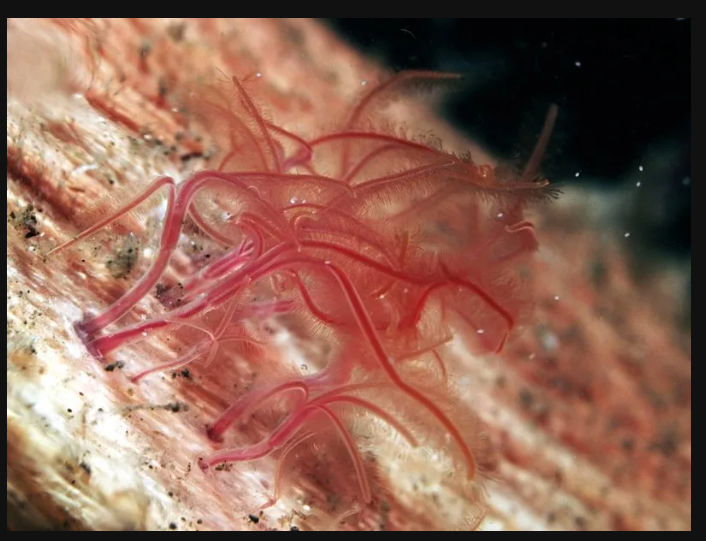
“Bone devourer.” It sounds like a name for a mythical, giant beast that lives in the darkest graveyards and the deepest forests. In actuality, this is the translation of the scientific name for an incredibly unusual genus of worms. At most a few dozen millimeters long, and first described in 2004, this worm is the genus Osedax, in the phylum Annelida and the family Siboglinidae. This makes them closely related to vent tube worms, the iconic deep-sea worms common among hydrothermal vent ecosystems.
Osedax worms, though they may seem small and unassuming, earn the meaning of their scientific name. They occur exclusively on the bones (and occasionally flesh) of vertebrates that die and fall into the deep sea. This most often means the remains large whales, though it can also include penguins, large fish, and alligators. These remains form ecosystems at the bottom of the sea, which many unique animals colonize, such as deep-sea sharks, giant isopods, and crabs. However, instead of consuming soft tissues like most of these deep-sea scavengers, Osedax worms instead feed directly on the bone, burrowing into it and dissolving collagen and lipids.
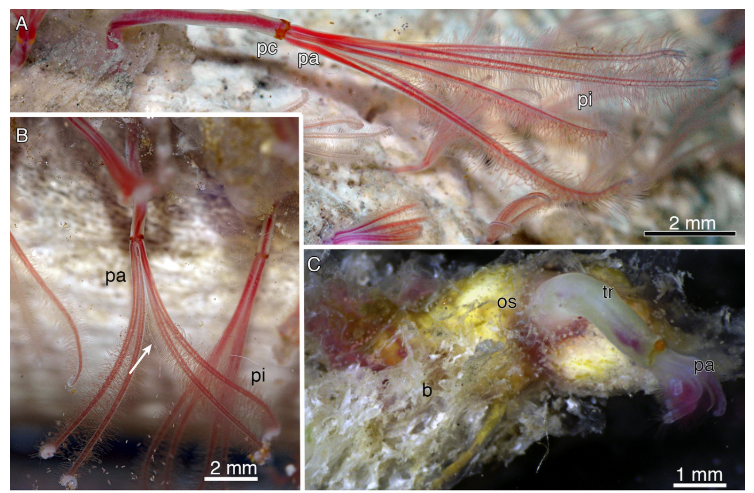
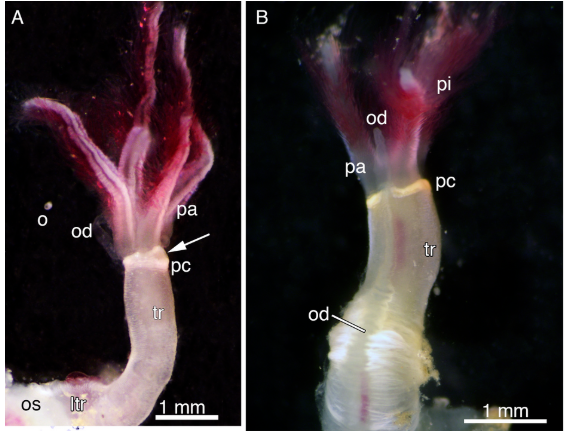
While they are in the same phylum as the common earthworm, Osedax worms look nothing like them. Their body can be easily described in three parts; the crown, the trunk, and the roots. The crown consists of four palps, or arms, which act as gills. Depending on the species, they may appear feathery or smooth, and range in color from red to white or clear. The crown also may include the oviduct, which is used for reproduction, though the location of this also varies by species. The trunk of the Osedax worm contains the rest of the oviduct and much of the circulatory system, with two central blood vessels running up and down the trunk. The trunk is otherwise composed of muscle and is surrounded by a thick tube of protective mucus.
The roots of the Osedax worm are the most unique part of its body. Closest to the trunk is the ovisac, where the eggs of the worm are stored. The rest of the roots, typically green in color, are composed of epidermis (skin) tissue and bacteriocytes, cells where symbiotic bacteria are stored. These roots secrete hydrogen ions, which work as an acid and dissolve bone in order to bore into the skeleton.
Every animal has to eat, so how do Osedax worms do it? Much like other species of Siboglinidae, Osedax worms lack a mouth and gut, so they rely on symbiotic bacteria that live within their roots to digest the collagen and lipids of the bone. These microbes are often anaerobic (live without oxygen), and are heterotrophic, which means that they consume organic matter in order to survive. When they eat the tissues of the bone, they share the nutrients they gain with the Osedax worm, in many ways a similar partnership to coral and the algae they host within their tissues.
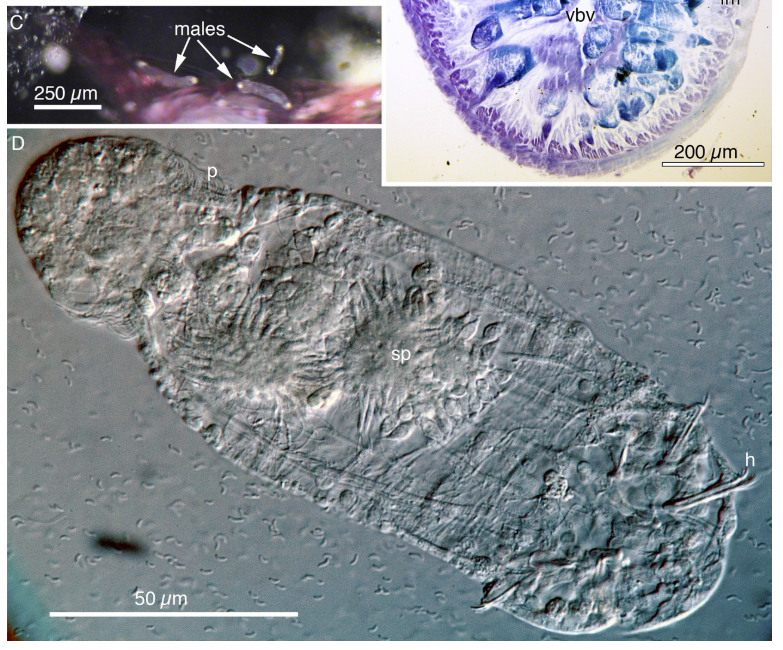
Many people have heard of the way that anglerfish reproduce, with a dwarf male clinging onto the female’s side, becoming little more than a means of reproduction. The Osedax worm has a similar story to tell. In the initial discovery of Osedax worms, researchers were puzzled to discover that there were only female worms found on the bones. Upon closer inspection, they found that microscopic dwarf males lived inside the oviduct of the female, continuously dispensing sperm. Once the eggs are fertilized, they are released into the water column, where they spread to other suitable habitats. While for many Annelids sex is determined genetically, it is hypothesized that for Osedax worms, it is determined by the environment the larvae land on. If the larvae land on bare bone, they develop to become female, while if they land on a female worm, they develop to become male.
To some, Osedax worms may seem terrifying. Dubbed “zombie worms” or “snot worms,” one immediately sees them as something to be looked at with disgust. But in reality, they are incredible, deeply complex animals, with a vital role to play in the ecosystems they actively consume. They hold within them countless mysteries on the nature of life at the bottom of the world, and the relationships formed between vastly different domains of life, and they should be looked at with the fascination they deserve.
Featured Image Caption: Zombie worms (Osedax roseus) eat away at the bones of a dead whale that has fallen to the seafloor. (Yoshihiro Fujiwara/JAMSTEC); https://ocean.si.edu/ocean-life/invertebrates/zombie-worms-crave-bone