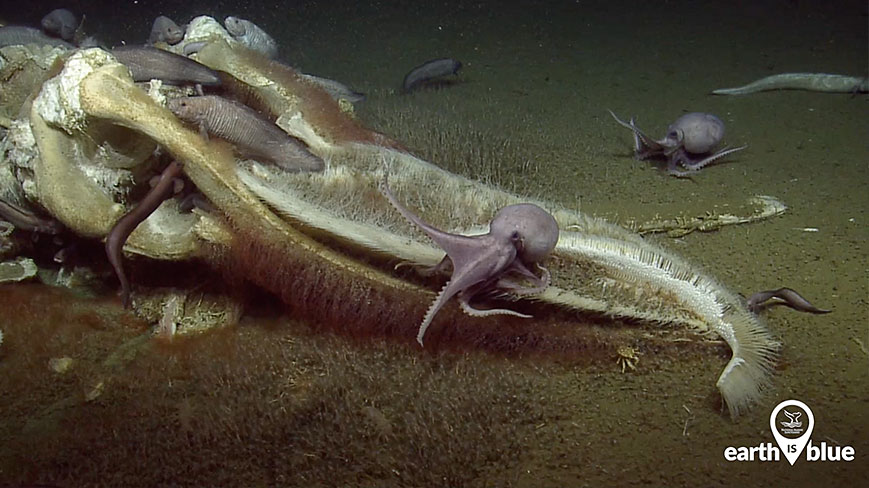
When people think of ecosystems they tend to think of fixed locations, but what if there were ecosystems that pop up out of seemingly nowhere and do not last long. An example of a so-called “pop-up ecosystem” is a whale fall. Whale falls are a unique ecosystem where after a whale dies its body slowly sinks to the bottom of the ocean. As the whale descends, other animals, from big to microscopic, arrive and consume the parts of the body. This ecosystem comes in four different stages: mobile scavenger stage, enrichment opportunist stage, sulfuric stage, and reef stage.
The mobile scavenger stage has its name because the organism that comes to the whale usually comes from quite far. The types of marine animals that are present in the 1st stage are hagfish, lobster, giant isopods, and Greenland sharks. These animals eat the skin and blubber of the whale only leaving decaying flesh for the next stage. This stage tends to be the shortest, only lasting four months to two years.
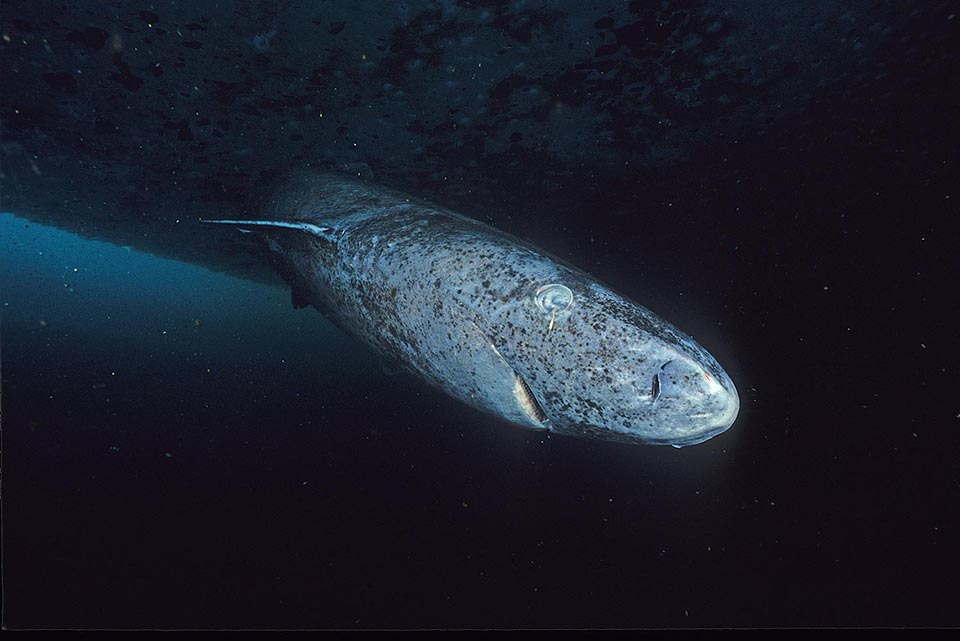
A photo of a Greenland shark (Somniosus microcephalus) which is one of the scavengers in the mobile stage. (Image credit: NOAA)
The enrichment opportunist stage is next. This stage lasts for about two years, after the big animals have had their fill animals like crabs, octopuses, smaller lobsters, and mussels colonize the carcass feeling on the leftover decaying flesh of the whale. While the bigger marine animals are feasting on the flesh they will expose the bones leading to the osedax worms to show up and burrowing holes into the bones which will expose the bone marrow which sets up the next stage of the whale fall.
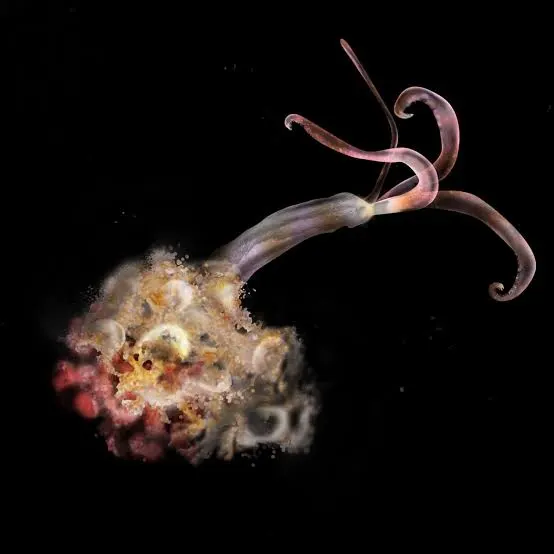
A close up of an Osedax worm that is responsible for burrowing into whale bone. (Image credit: The Guardian)
Now comes the sulfuric stage, this when bacteria penetrates into the open bone marrow to feed. When they do feed it breaks down the skeleton and they release sulfur as a byproduct, and this attracts chemosynthesizers who cluster around the whale skeleton making it almost look like a rug. This clustering attracts other organisms like tube worms, snails, and chemosynthetic mussels and clams. This stage (as far as we know) is the longest, lasting from fifty to one hundred years. After all this is over with organisms such as sponge and deep sea coral colonized the stripped skeleton. It is called the reef stage but despite it being considered its own separate stage, it has not been observed enough to give further information.
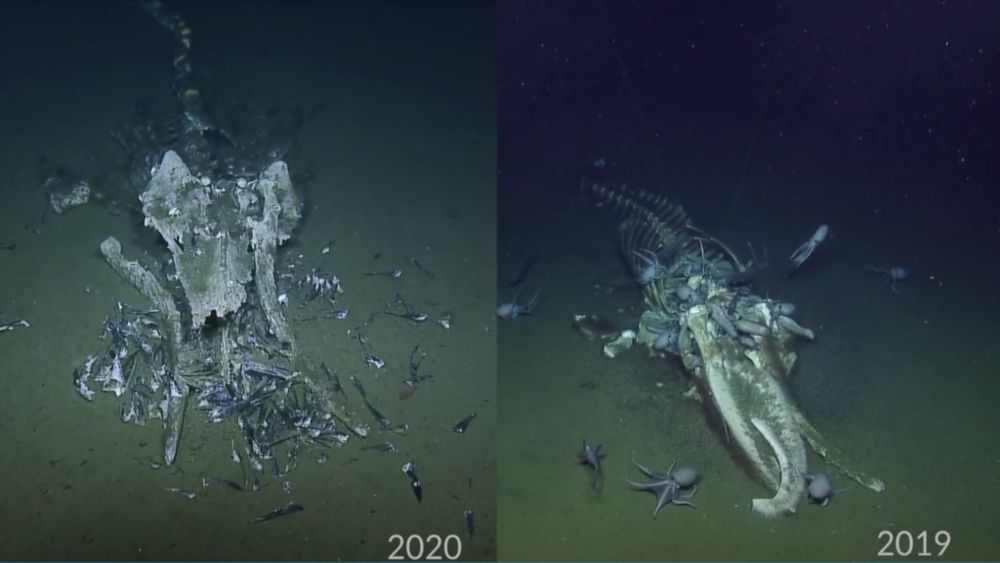
One year of difference in a whale fall at more than 30.5km underwater (Image credit: NOAA)
Whale falls ecosystem gives a home and life to more than 3,000 species of marine life. The bottom of the ocean tends to be a barren wasteland with only sparse eco hotspots, but whale falls acts as a temporary oasis for marine life. It is difficult to study this ecosystem because the ocean’s bottom is not fully mapped. This is an ecosystem that can pop up almost anywhere and in a big ocean, that’s like finding a needle in a haystack. On top of that, this environment comes in stages that are relatively short, except for the sulfuric stage which is so long that it can be difficult for scientists to study in its entirety, so by the time scientists find it two or more stages could have passed. Despite that, scientists do have ways to search for whale falls such as: sonar technology, using remote operated vehicles and using parts of beached whale carcasses to study this under-researched ecosystem.
Feature image: a video still of octopuses feasting covering a whale carcass (Image credit: NOAA)