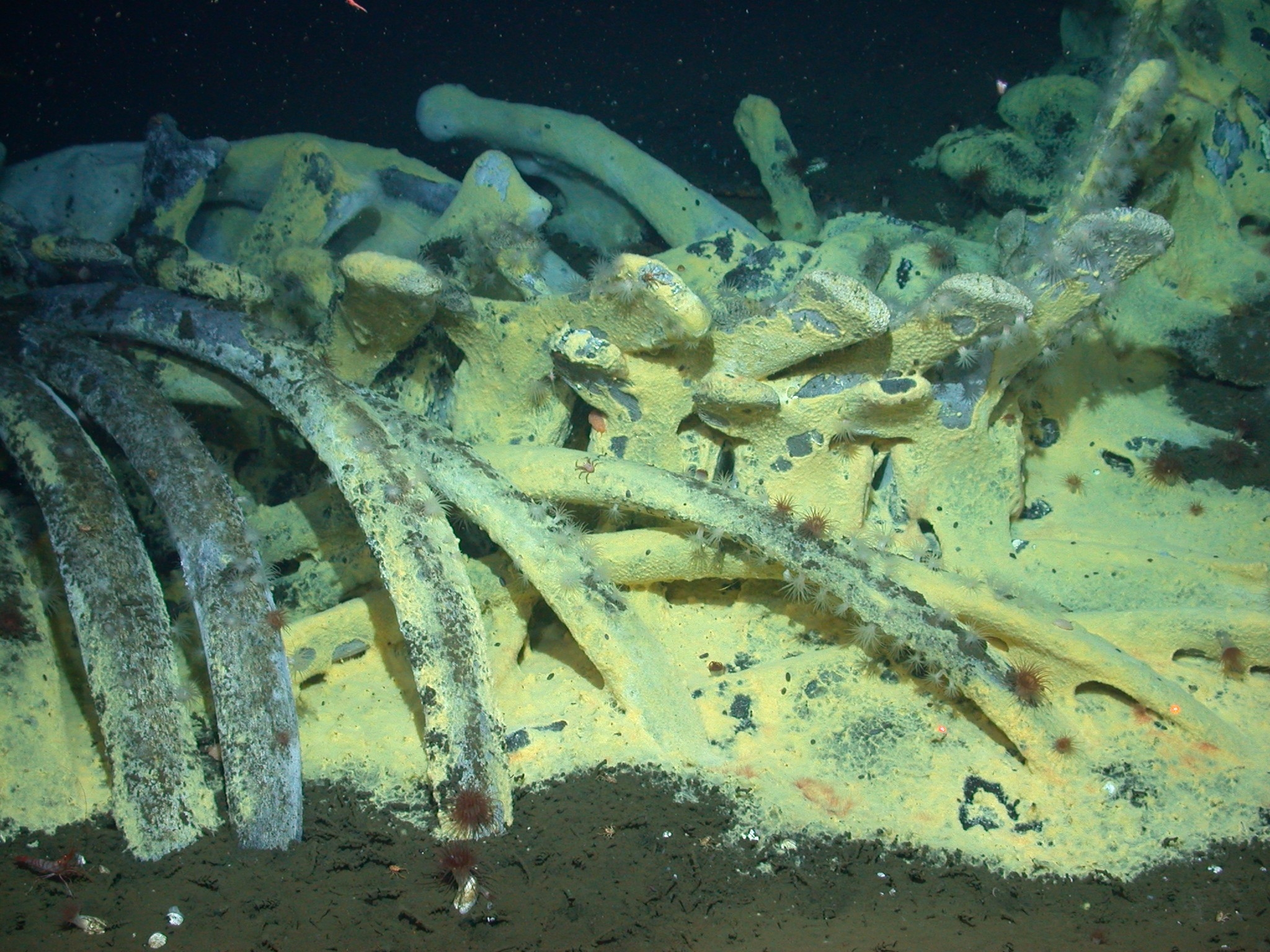
When any type of waste or detritus is generated in the open water of the ocean, gravity causes it to drift slowly down to the sea floor. Typically, these particles are small, the size of a crumb, or, at most, a few centimeters, and are called marine snow. However, they can be larger, in the form of dead organisms such as fish and birds, and are then called food falls. Most notable of these food falls are those of whales, called whalefalls. Unlike other food falls, which are typically scavenged within days or less, whalefalls remain on the ocean floor for decades supporting their own specialized ecosystems. Their nutrient content can be equivalent to two thousand years’ worth of marine snow. These ecosystems form in three, possibly four, successional stages.

In the first successional stage, known as the Mobile Scavenger Stage, mobile, or nektonic, animals gather around the whale, both while it is sinking through the water column, and once it hits the sea floor. These organisms, including Greenland sharks, hagfish, and giant deep-sea isopods, remove much of the flesh from the whale in a span of four months to two years.

In the second successional stage, known as the Enrichment Opportunist Stage, there are few chunks of flesh still on the bone, and there are many smaller particles of food around the whale fall. Instead of larger animals such as sharks, smaller organisms like octopuses, crabs, squat lobsters, and mussels colonize the whale. They are able to feast on the smaller skin and flesh particles. In the process of mobile scavengers stripping the skeleton, large expanses of bone are exposed. This opens the whale to a unique scavenger, osedax worms, which are able to consume the bone itself. This stage of the whalefall can last around two years.

The most astounding stage of the whalefall ecosystem, even if only for its own unexpectedness, is the Sulfophilic Stage. Sulfophilic means to be attracted to sulfur, and in this case describes the stage where a chemosynthetic environment forms around the whale skeleton. When osedax worms in the enrichment opportunist stage burrow into the bone of the whale, they allow anaerobic bacteria to access the lipids, inside the bone marrow. As they consume this, they release sulphates as a byproduct.
These sulphates then feed chemosynthetic bacteria, a different kind of primary producer. Instead of relying on sunlight to produce glucose, chemosynthetic organisms rely on inorganic substances such as sulphates, methane, and iron. They oxidize these substances, and use the energy produced to create sugars. The presence of these bacteria allows for an entire chemosynthetic ecosystem to develop, including tube worms, chemosynthetic mussels and clams, and snails. This ecosystem stage can last from ten to over fifty years.

The Reef Stage of a whale fall is when the skeleton has been completely stripped bare, and can serve as a home for suspension feeders such as sponges and coral. This stage has been infrequently observed, and is poorly recorded in scientific literature, so there is much to be learned about its ecology and very existence.
The structure and diversity of whalefall ecosystems cements them as an incredible aspect of deep sea life. Over the course of its “life,” a whalefall can support at least 12,490 organisms on a single skeleton, and up to 407 species. It allows for the cycling of nutrients to the deep sea, and may even contribute to the dispersion of species throughout the deep. While we may not know the true extent to which whale falls contribute to the deep sea, it is clear that they are fascinating ecosystems well worth studying.
Featured Image: The sulfophilic stage of an implanted whalefall ecosystem off the California coast. Image Credit: Craig Smith, University of Hawaii, 2004, California, Santa Cruz Basin, Channel Islands; Image from NOAA