
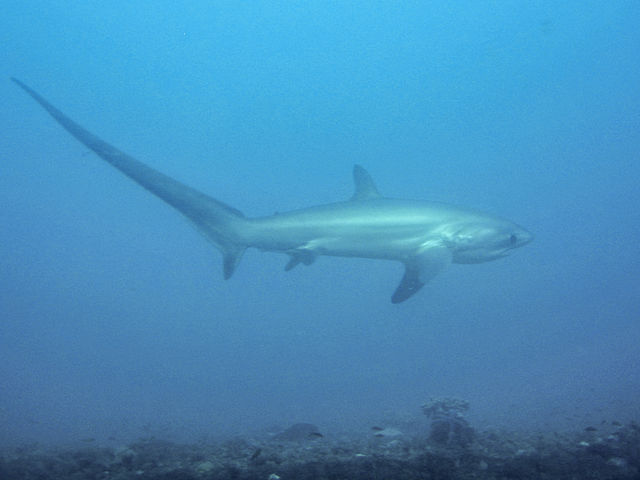
Thresher sharks are mackerel sharks of the family Alopiidae, ranging from approximately 10 to 20 feet in length depending on the species. The three extant species, Common thresher, Bigeye thresher, and Pelagic thresher, are immediately recognizable by their extraordinarily elongated upper caudal fin, which can measure up to half the length of their total body. This defining feature is not merely for show; it is a highly specialized evolutionary adaptation that distinguishes the genus Alopias from all other sharks, serving multiple functions from enhancing propulsion during steady swimming, to being most famously used as an advanced hunting tool in pelagic waters.
All three species exhibit a decreasing population trend due to fishing pressure, bycatch, and slow reproductive rates. Expanding our understanding of their biology and ecological role is essential for conservation efforts and for raising awareness of their importance within marine food webs.
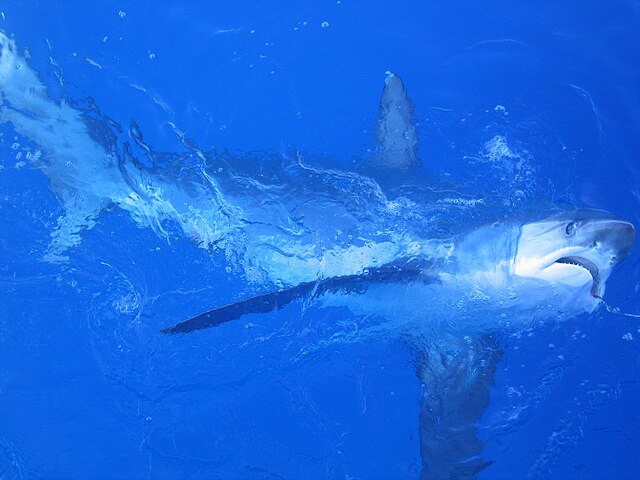
Like most sharks, threshers pose little threat to humans and show no particular interest in them. Their intimidating morphology masks a generally cautious and elusive nature. Ecologically, they function as mid- to upper-level predators. Their diet consists largely of schooling pelagic fishes such as mackerel, anchovies, sardines, hake, and barracudina, as well as various cephalopods including squid species. Diet composition varies somewhat among species: bigeye threshers often feed on mesopelagic fish and squid at depth, while pelagic threshers show a strong reliance on squid and small schooling fish in open ocean environments.
Two primary hunting behaviors have been documented in thresher sharks. The first involves herding and compressing a school of fish. The shark flexes and rounds its body, forming a tight curvature before accelerating upward and delivering an overhead whip with the tip of its elongated caudal fin. This motion generates a high-velocity strike capable of stunning or killing multiple prey items simultaneously. The second method occurs when the shark swims alongside a school, using rapid lateral tail flicks to strike adjacent fish. Both strategies function to immobilize prey prior to consumption.
Studies observing free-swimming pelagic threshers found that overhead tail strikes average speeds exceeding 30 miles per hour, with some recorded near 50 miles per hour. Interestingly, while the dramatic overhead strike succeeds roughly a third to half of the time, lateral tail strikes show a much higher success rate, around 90% in some behavioral analyses. The biomechanics behind these movements reveal that tail-slapping differs from normal locomotion, requiring rapid flexion and muscular coordination beyond standard swimming motions.
Despite this growing body of research, little is known about the energetic cost of repeated high-velocity tail strikes. The metabolic demands of such rapid acceleration and force generation remain an open question in thresher shark physiology. Understanding these energy trade-offs could provide deeper insight into their hunting efficiency, habitat use, and ecological limitations.
Featured image shows a bigeye thresher swimming in the photic zone (Alopias superciliosus). (Image from pixabay).