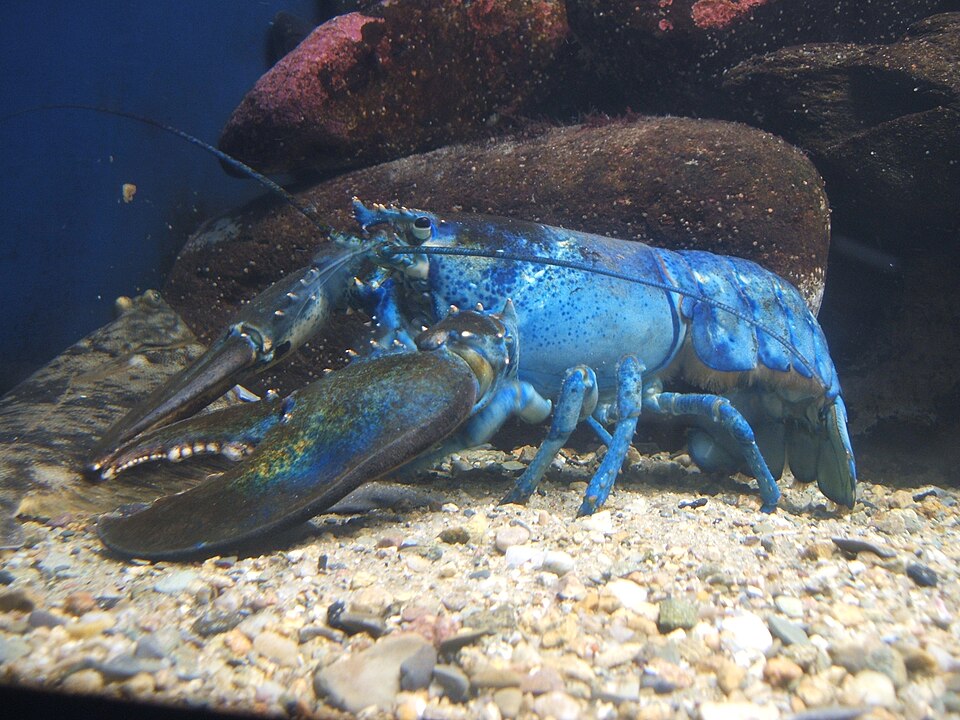
A couple years ago in our very own back yard of Rhode Island. We found a rare 1 in 100 million lobster. This normally dark greenish-brown sea crustacean was found to be a bright electric blue. The color wasn’t due to paint, pollution, or its diet, but actually its genetics. In every Lobster’s shell, there is a pigment that causes it to be red when cooked called astaxanthin. In most lobsters there is a protein binding to it and shifts its appearance to a darker more camouflaged colors. which help them hide among the terrain of the ocean floor. But in extremely rare cases a mutation can occur. this causes the lobster to produce abnormal amounts of the protein, as a result it changes how light reflects off the shell making it go from a darkish color to a more Vivid blue.


Because lobsters depend on the color of their shells in order to avoid predators like sharks and seals, this change in their shell color is actually a disadvantage in the wild. The bright blue of the lobster shell stands out sharply against the ocean floor making these lobsters easier for predators to spot. The actual chance for them to naturally occur is around 1 in 2 million, but because they have a low chance of survival the chance for us to catch ones closer to 1 in 100 million.
The iconic red color of a lobster only appears when it is cooked. Heat breaks apart the proteins surrounding the pigment astaxanthin, revealing the bright red color underneath. this causes even rare blue lobsters turn the same red color when cooked. due to this most fishermen and restaurants choose not to cook the rare lobsters. And are usually donated to aquariums or research facilities. Just recently there was a blue lobster named Neptune that was donated to Northeastern University’s Marine Science Center.


In Rhode Island and our surrounding East Coast, rare Lobsters appear more often than most other places, this is due to the sheer volume of lobster fishing in this region. Oftentimes thousands of traps are brought in daily, increasing the chance of us catching a genetic mutation. On the rare chance that one is found, it often becomes local news and shown around the community. For example in 2018 blue lobster was caught near Newport and for a short period of time was displayed at the Newport Lobster Shack before being released. I personally feel it is always good to show the community these special Marine creatures, as it shows how much biodiversity we really have in our own Waters.
Ultimately the blue lobster represents more than just a unique catch. It can be used as a catalyst, to show how small genetic changes can drastically alter an organism’s appearance and its chance for survival in nature. In an ecosystem defined by tradition and routine, a single blue lobster is a reminder that even in well known ecosystems, the ocean still has surprises waiting for us.
sources
- featured image – image of a bright blue lobster on the sandy bottom of an aquarium – from wiki commons
- National Geographic – Rare colored lobsters
- Northeastern University – Marine Science Center (Blue lobster “Neptune”)
- University of Massachusetts Dartmouth – School for Marine Science & Technology
