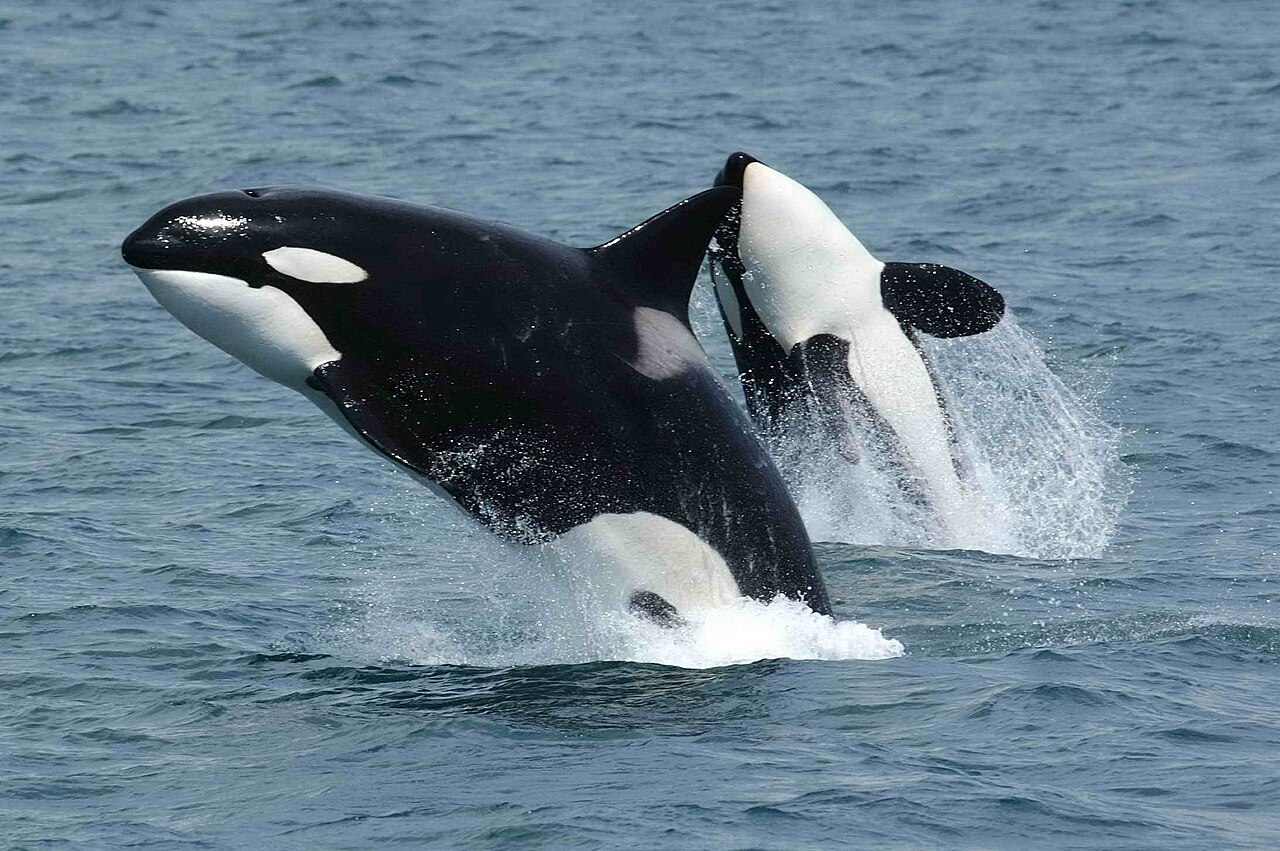
Two orcas jumping out of the water off the coast of Alaska. Credit: Robert Pittman (NOAA/Wikimedia Commons)

In 1987, off the coast of the Pacific Northwest, a female orca was spotted with an unusual accessory. Balanced atop her head was a dead salmon, worn as if it were a hat. This orca became a trendsetter, and soon, her entire pod were sporting ‘salmon hats’. A few weeks later, the trend had stopped almost as fast as it started. However, the salmon hat may once again be back in vogue.
In 2024, 37 years after the original salmon hat craze, orcas in Puget Sound, Washington were spotted displaying what looked like similar behavior to the 1987 trend. Some scientists hypothesize that the same individuals who started the trend 37 years ago may be starting it again. Andrew Foote, an evolutionary ecologist at the University of Oslo in Norway states that “It does seem possible that some individuals that experienced [the behavior] the first time around may have started it again.” However, the orca originally spotted reigniting the trend, known as ‘J27 Blackberry’, is actually only 32, 5 years too young to have been around for the original salmon hat trend. This leads to the hypothesis that the behavior is somehow passed down between generations like a cultural tradition. However, the exact reason for the brief resurgence of the trend is still unknown.
But what is the true reasoning behind orcas sporting salmon hats in the first place? The answer is that no one truly knows the purpose of this orca populations’ short-lived fashion statement. However, a few hypotheses exist that may explain the behavior. One hypothesis states that some populations of orcas simply create fads that serve no real purpose. Some scientists suggest the hat may simply feel good to the orca. The most popular hypothesis states that there is an abundance of salmon in the environment these orca populations reside in. The population of orcas observed sporting salmon hats, known as southern resident orcas, feed exclusively on salmon. Therefore, the orcas may simply be saving a snack for later by balancing it atop their head. Orcas are known to do similar ‘stashing’ behaviors in other parts of the world. For example, some mammal-hunting orcas carry large chunks of food under their pectoral fins to save it for later. But since salmon are much smaller than the large mammals those populations of orcas eat, they may not be able to securely hold them under their pectoral fin, and instead opt to place it atop their head.

Salmon hats are not the only known orca trend, however. In addition to the fabled salmon hats, a subpopulation of Iberian orcas have been known to attack boats in the waters surrounding the Iberian peninsula. Since 2020, hundreds of incidents of orcas attacking boats have occurred. The true reason, like salmon hats, is unknown, but most scientists believe the orcas now see it as a game, becoming a cultural element for the local Iberian orca pods. These odd occurrences have taught us that orcas are capable of creating cultural fads and trends similar to how humans do.