Cephalopods are known for their astonishing ability to rapidly change color and shape, and the Giant Cuttlefish (Sepia apama) is no exception. Cuttlefish have extremely impressive displays of color during courtship. They use their skin to display an aggressive pattern to ward off competitors, or they can use it to impress a female by flashing all the colors in the rainbow. They can also make intricate patterns on their skin that move to hypnotize the female. They have even been observed splitting their skin pattern in half, where the side facing the female displays a flamboyant pattern to impress her, and the side facing a rival male shows an aggressive black and white striped pattern.
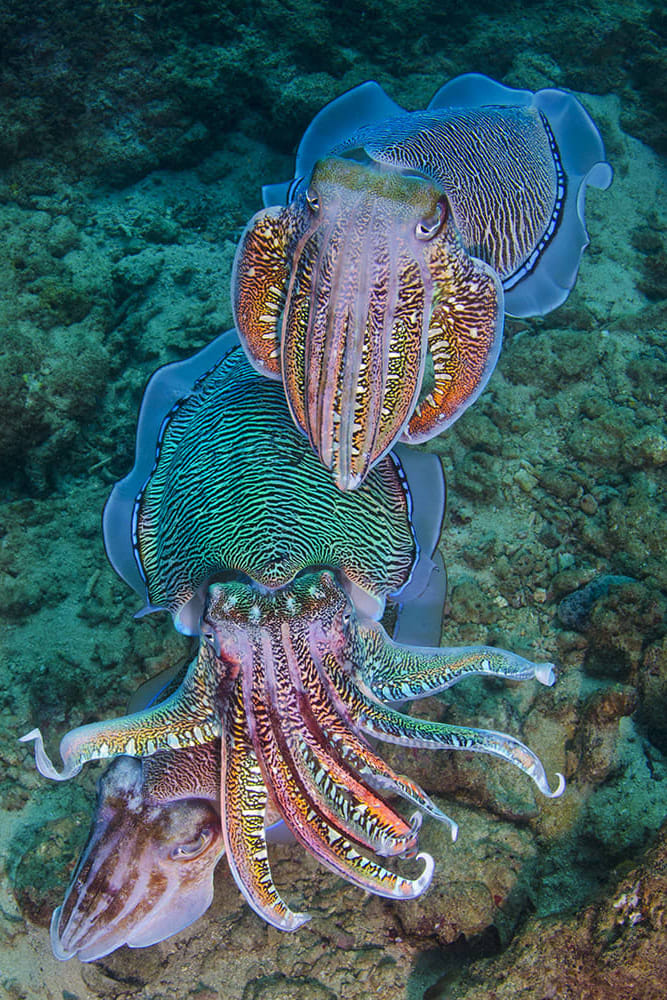
Large male protecting female from another male, photo by: Dhritiman Mukherjee
Cuttlefish can do this with their skin due to specialized cells called chromatophores, a distinct feature of cephalopods. These cells rapidly communicate with the brain to expand and close, creating amazing visual patterns used for courting and camouflage. The cuttlefish brain is made of 32 different lobes with specialized features. The two largest of those lobes are optical lobes, allowing them to take in massive amounts of visual information of their surroundings so they can acutely camouflage. These highly developed lobes as well as their memory and learning are the keys to their impressive visual displays, as well as their camouflage.

Thousands of giant cuttlefish gather off the south coast of Australia from late April into August for mass mating. Competition between male cuttlefish is intense, often leaving them wounded. They combine many strategies such as size, strength, and color display to fight off other males. They use their tentacles to make themselves bigger and fight one another with their beaks. This fierce competition has forced the smaller males to evolve unique strategies to successfully pass on their genes.
This is where the cross-dressing comes in. Small male cuttlefish have recently been observed changing their shape and color to mimic female cuttlefish. They wait until two bigger cuttlefish start fighting one another, and then he swoops next to the female and changes back to a male to court her, often with success. When the larger male returns, the smaller one changes back to female patterns, and the large cuttlefish remains passive and focuses on fighting other males. In some cases, the larger male was aggressive and separated from the female, in which case the smaller male either continues impersonating a female, or changes back to a male display and mate-guards the female.
This strategy is very successful for smaller males; however, female cuttlefish are very picky. After the male gives the female his sperm packet, she can still choose to discard it if a better mate comes by. Female cuttlefish do this for every size male and have been observed to copulate many times with many different males before choosing a suitable one to fertilize her eggs. Female cuttlefish also use their skin to communicate when mating. Studies found that females displaying a white lateral stripe were less likely to mate with a male. These displays could be used to show the males when a female is most fertile, and ward off males when she is not receptive to mating, allowing males to be more selective with their mating to ensure reproductive success. Cuttlefish have evolved fascinating mating tactics to ensure their reproductive success. Their ability to rapidly change skin color, as well as communicate their emotions to others shows highly developed brains and visual processing. Maybe more male species should learn to cross-dress from these flamboyant males.