Coral reefs are an important marine habitat to many species as they support marine life diversity, provide protection, and contribute to coastal protection as well as ecotourism. As climate change intensifies, especially with rising global temperatures, coral reefs face increasing environmental stress, placing species that rely on coral reefs at risk. An important aspect of coral wellbeing relies on their symbiotic relationship with Zooxanthellae, microscopic algae that live within the clear tissue of coral. This mutually beneficial relationship allows Zooxanthellae to receive nutrients and protection, while providing coral with energy through photosynthesis as well as contributing to their bright colors. When subjected to stress conditions including high temperatures, low salinity, or pollution, this relationship becomes ineffective, causing the coral to expel the algae to increase the coral’s chance of survival, leaving its white calcium carbonate skeleton behind.

This image shows the calcium carbonate skeleton that is exposed after the Zooxanthellae are expelled from the coral. (Image by: Vardhan Patankar via Wikimedia Commons licensed under Creative Commons Attribution-Share Alike 4.0 International)
Coral bleaching effects different groups of coral in a variety of ways based on geographic location, species, and the severity of poor environment. Although some coral can recover, the continued stress can delay this process and can impact their reproductive abilities and increase susceptibility to disease. The reasons behind differing responses are still unknown which is why it is essential to make an effort to understand, like many scientists are aiming to do in order reinforce restoration efforts. The changes that take place during bleaching periods also have impacts on the marine life that rely on coral structure as a habitat. Small fish use small holes and cracks in coral for protection however, after undergoing this stressful event, coral does not always revert back to its complex structures, leaving these fish without a place to live, forcing them to seek shelter elsewhere.

A whitespot hawkfish in Swains Island in American Samoa, using coral as a perch to observe its environment, showing one example of fish using coral reefs for protection and shelter. (Image by: NOAA Fisheries)
A big driving force to coral bleaching is climate change. Anthropogenic climate change is causing warmer oceans which leads to increasingly frequent and severe mass coral bleaching events. Seasonal surface temperatures even just 1ºC above the average can lead to considerable amounts of stress response in coral ecosystems. For example, the Great Barrier Reef has experienced multiple bleaching events since the late 1990s and there are still reports today, including the consecutive events in 2016-2017, marking their third global bleaching event. The Australian Institute of Marine Science is working to monitor coral bleaching events and study responses to different stressors in an effort to predict future scenarios.
On another note, NOAA’s scientists recorded the fourth global bleaching event in 2024, being the biggest to date at the time, and the second in a decade. Heat-stress levels, which have been monitored by by NOAA’s Coral Reef Watch (CRW) through sea surface temperature data, have been extensive across the Atlantic, Pacific and the Indian Ocean basins. This has now become the largest mass bleaching event affecting territories around the world.
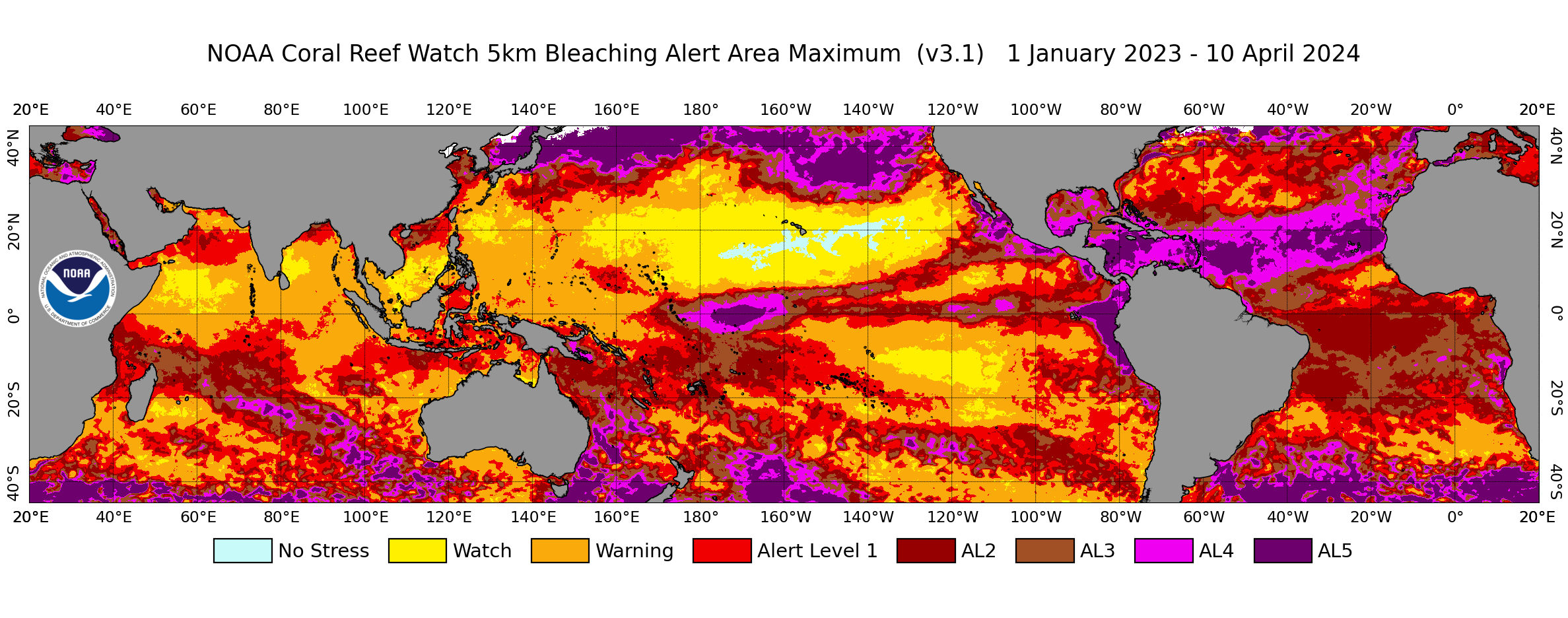
This graph from NOAA data displays different bleaching alert areas in the ocean ranging from “no stress” to “AL5” (alert level 5). Bleaching conditions have reached significant alert levels especially in the Northern and Southern Hemispheres.
All in all, high temperatures, pollution, and other human-driven factors play a role in the global issue that is coral bleaching. These threats have been jeopardizing the wellbeing of countless marine species that rely on coral reefs for shelter, food, and breeding. Being able to protect these reefs through conservation and restoration efforts is essential to protecting reef ecosystems and maintaining all the functions that they provide to our oceans.