The Ocean is one of the most fundamentally important things to all life on Earth. More than 2,000,000 species are known to call the oceans home, and it’s estimated that millions more species are yet to be discovered. However, the health of the oceans has been suffering more and more as the demand for natural resources and food, among other commodities, increases. Today’s market focuses on maximizing profit and leaves little room for sustainability or conservation of natural ecosystems and the benefits they provide to humanity and the natural world. One of the hardest hit oceanic communities has been Coral reefs.
Coral reefs are like underwater cities, full of diversity and vital for ocean health. Unfortunately, reefs face threats from overfishing, unethical tourism, rising sea temperatures, and ocean acidification, leading to habitat loss all around the world. Conservationists are exploring solutions, such as super corals, which are genetically modified or selectively bred to withstand high temperatures. The aim is to repopulate and restore these critical habitats, allowing them to spread and revive the vibrant coral reef communities.
To understand how super corals work, it is important to first understand the complex symbiotic relationship of the coral organism. In most cases, corals are the result of a partnership between microalgae and tiny marine organisms called polyps. The polyps provide a living space for the microalgae, which in turn provide essential nutrients or other benefits to the coral. The extreme variety of colors and shapes on a coral reef is a direct result of these two organisms’ collaboration. Coral and microalgae’s relationship will suffer consequences due to the rising temperatures. The microalgae are unable to cope with the rising temperatures of seawater induced by climate change. Microalgae then evacuate the polyps, leaving them without vital nutrients. This causes the discoloration on reefs known as “bleaching.” The polyps are left in a vulnerable state in hopes their symbiotic partner will be able to return. In most cases, the water temperatures prevent the recolonization of reefs, and ultimately, the polyps die.
Super corals, however, house symbiotes (the microalgae) that are tolerant of extreme changes to their environment. In some studies, these corals were able to withstand temperature changes of 6 degrees Fahrenheit, whereas average corals struggled to survive changes of 1-2 degrees. Scientists are discovering corals like this around the world and are racing to understand how these reefs work. These super corals help maintain the health of the reef and create biodiversity hotspots in the oceans, vital to the diversity of not only the reefs but also the areas. Some organizations, like the Coral Gardeners, are even growing these supercharged corals in the safety of a controlled environment and then distributing them to nearby reefs in hopes of stabilizing these fragile ecosystems. The ultimate goal is that by researching and understanding these superheroes, conservationists can better protect reefs and pass legislation that will serve to ensure the sustainability of the oceans.
Although super corals are a promising lead in the field of conservation, their potential is questionable. Rising sea temperatures are not the only variable impacting reef health in the oceans today. Although these temperature-resistant strains of corals can protect a reef from climate change, it is unlikely that they would be able to withstand changes to the pH and would certainly still be impacted by overexploitation. Basically, the field of coral reef conservation is not a one-dimensional battle, and conservationists are on the clock to save these rapidly deeplting habits.
Coral Reefs are one of the most important places on this planet, and they are critical to almost every marine ecosystem that exists in the oceans. In spite of the super corals’ flaws its ability to withstand the changing temperatures of waters around the world is still a critical advantage. At the very least, pursuing the distribution of super corals can at least buy conservationists and scientists more time in the race to protect reefs. More research and funding will be needed in order to fully understand the full potential of these rare corals.
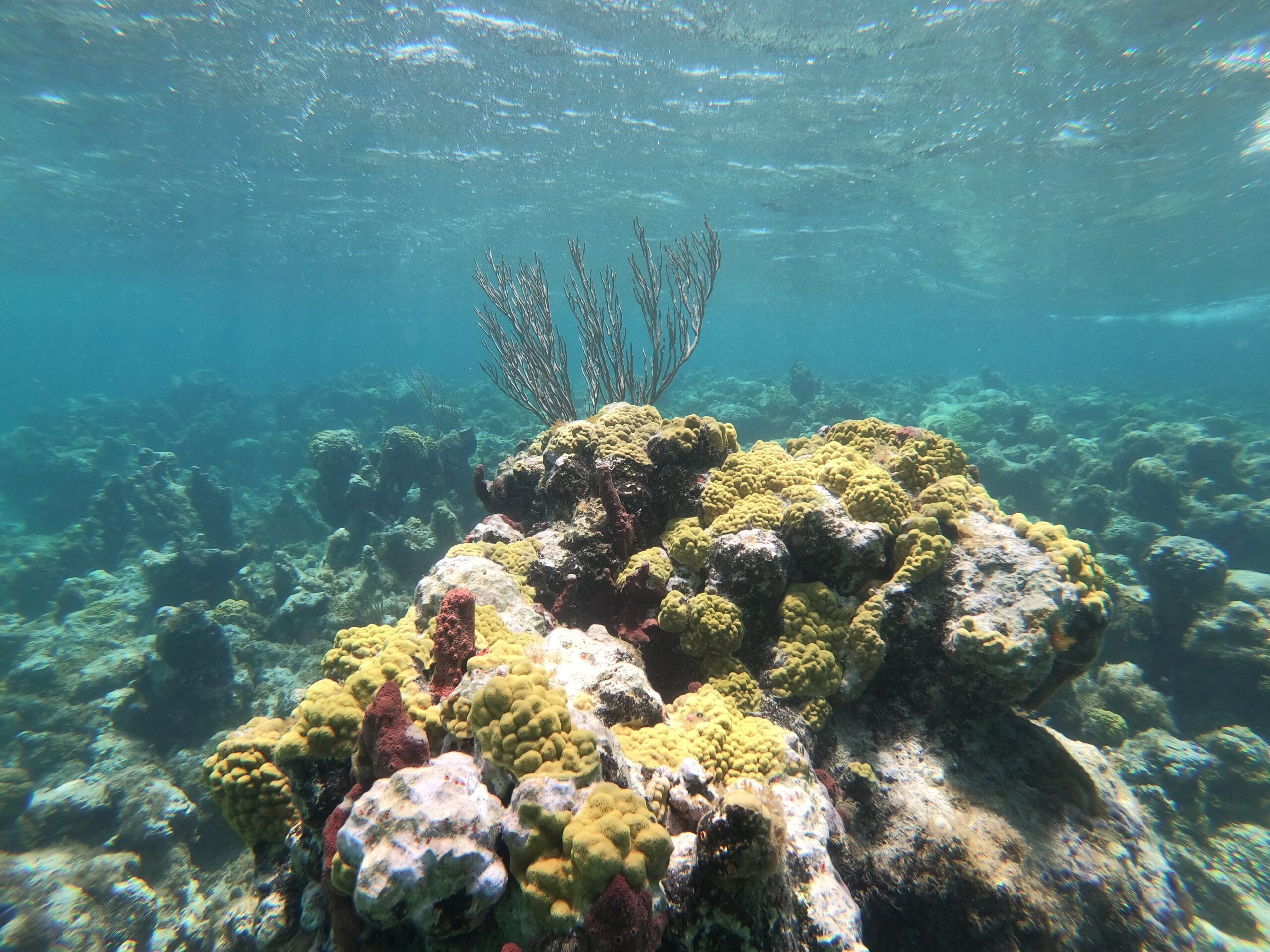
Featured Image: Healthy brian corals populate a rocky reef structure. In the background, anchored algae floats in the sunlit waters. Picture taken in Key West, Florida (Photograph by Author)