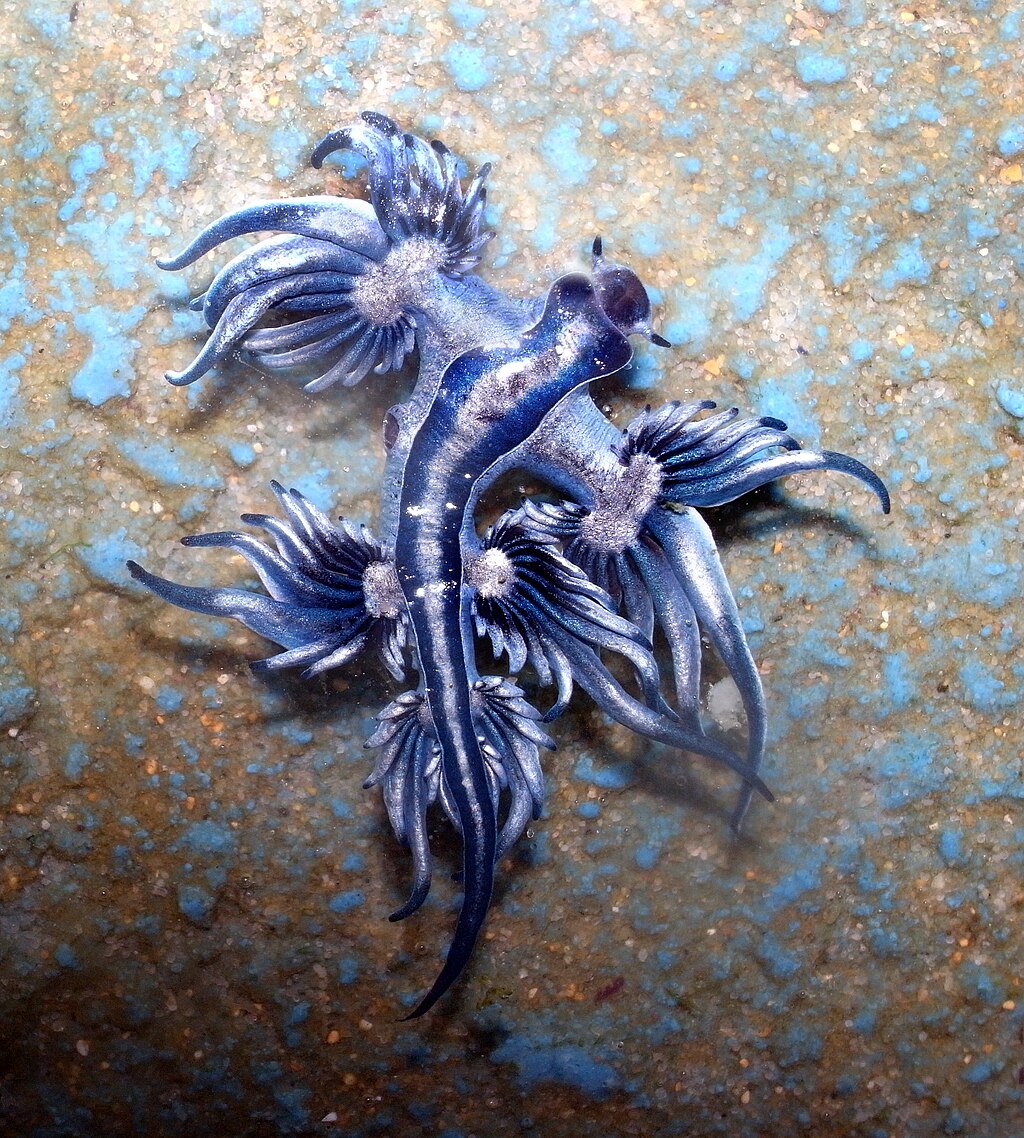
When thinking about our world’s oceans, many of us consider grand animals such as whales, dolphins, sharks, and more. However, our oceans hold a plethora of life that holds unique qualities sometimes overlooked. One of these creatures being Glaucus atlanticus, better known as the Blue Dragon. These creatures are a part of the Nudibranchs family, and live out their lives in the pelagic zones of the ocean. They were first recorded in 1770 by German scientist Georg Forster in Mexico and later recorded in 1875 when a specimen was collected during one of The Challengers Expeditions in the Pacific.
Blue Dragons are typically distributed in more tropical regions of the Atlantic, Pacific, and Indian oceans. However, in 2022, likely due to climate change and changing current patterns, they were not only found close to Australia but also washed up along the Texas Gulf Coast. They get washed up due to an air sac within their stomachs that allows them to float atop the water’s surface.
This adaptation has led Blue Dragons to rely on the ocean’s currents and winds for transportation and dispersal. Furthermore, since the sac is within their stomachs, this causes their ventral side to face upwards towards the surface while their dorsal side is facing towards the depths. Their pigmentation, however, have evolved to correlate with these orientations. Their dorsal side is a white/grey coloration to blend in from above, while their ventral side is dark blue to blend in from predators below.
.jpg)
Blue Dragons do not rely solely on camouflage. In fact, their main source of defense comes from their primary prey, the Portuguese Man o’ War. Blue Dragons are immune to the stings of these siphonophores, which allow them to deflate their air sac, cling on, and eat the main body and stinging tentacles from the bottom. Furthermore, through a process called kleptoconidia, they intake only the most potent nematocysts and turn them into their own defense.
They then store these into specialized sacks called cnidosacs found at the tip of their tentacle structures.
Thanks to the high concentration within the cnidosacs, the strength of the nematocysts can be amplified to be stronger than the Man o’ War itself. In some rare cases there have been deaths, but those individuals had prior medical issues. Typically, the worst cases are nausea and vomiting. In the end, these creatures are a small yet unique treasure in a vast ocean we have yet to truly explore.
Cover Image: Glaucus atlanticus. Photograph by Sylke Rohrlach. Source: Wikimedia Commons. Licensed under (CC BY-SA 2.0).
.jpg)