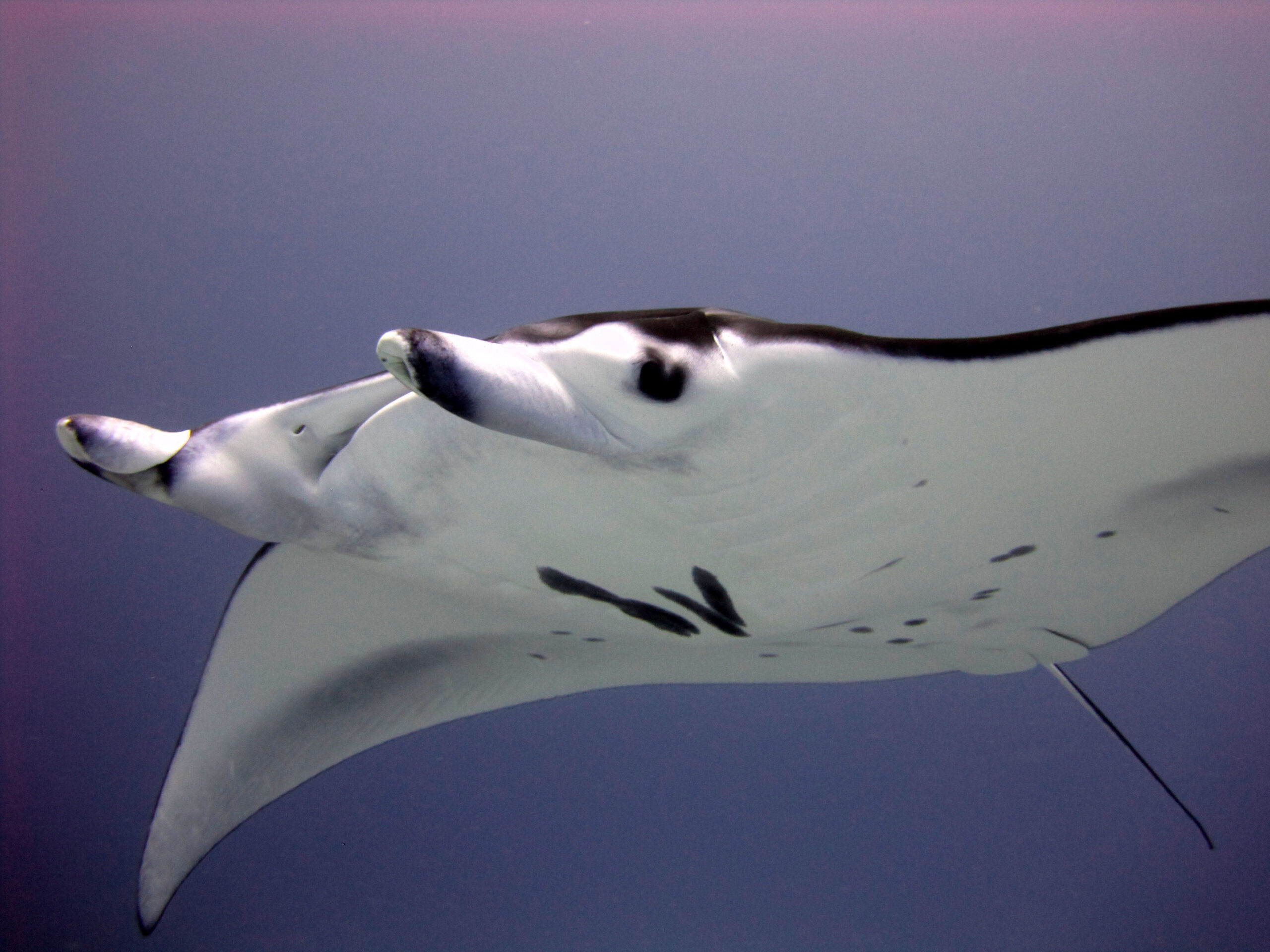
Manta rays are often portrayed as slow, relaxed, effortless gliders, but as food becomes abundant, their behavior reflects a much more strategic approach. As large amounts of plankton move in, manta rays exhibit a wide array of specialized feeding strategies. These strategies allow them to capture as much prey as possible while expending very little energy.
One feeding strategy rays often shift to is known as barrel-roll feeding. In this feeding example, they perform repeated vertical loops throughout the water column. This allows them to remain within a specific patch of highly concentrated prey and continuously re-enter the same plankton-rich area. Rather than swimming in a straight line through their prey patch a single time – which requires substantially more energy – multiple rays may engage in this feeding strategy simultaneously for extended periods during particularly dense blooms.
In even more extreme feeding conditions, manta rays may escalate from individual barrel-roll feeding to a unique, coordinated group behavior known as cyclone feeding. During these events, mantas swim together in a circular motion that can extend from the seafloor all the way to the surface. This motion creates a vortex that concentrates plankton into a specific feeding zone, making it possible for the rays to exploit dense prey patches with outstanding efficiency. This distinctive strategy is quite rare and has been documented in only a few locations worldwide, most notably in Hanifaru Bay Marine Protected Area, where exceptionally high plankton accumulations support this kind of foraging.
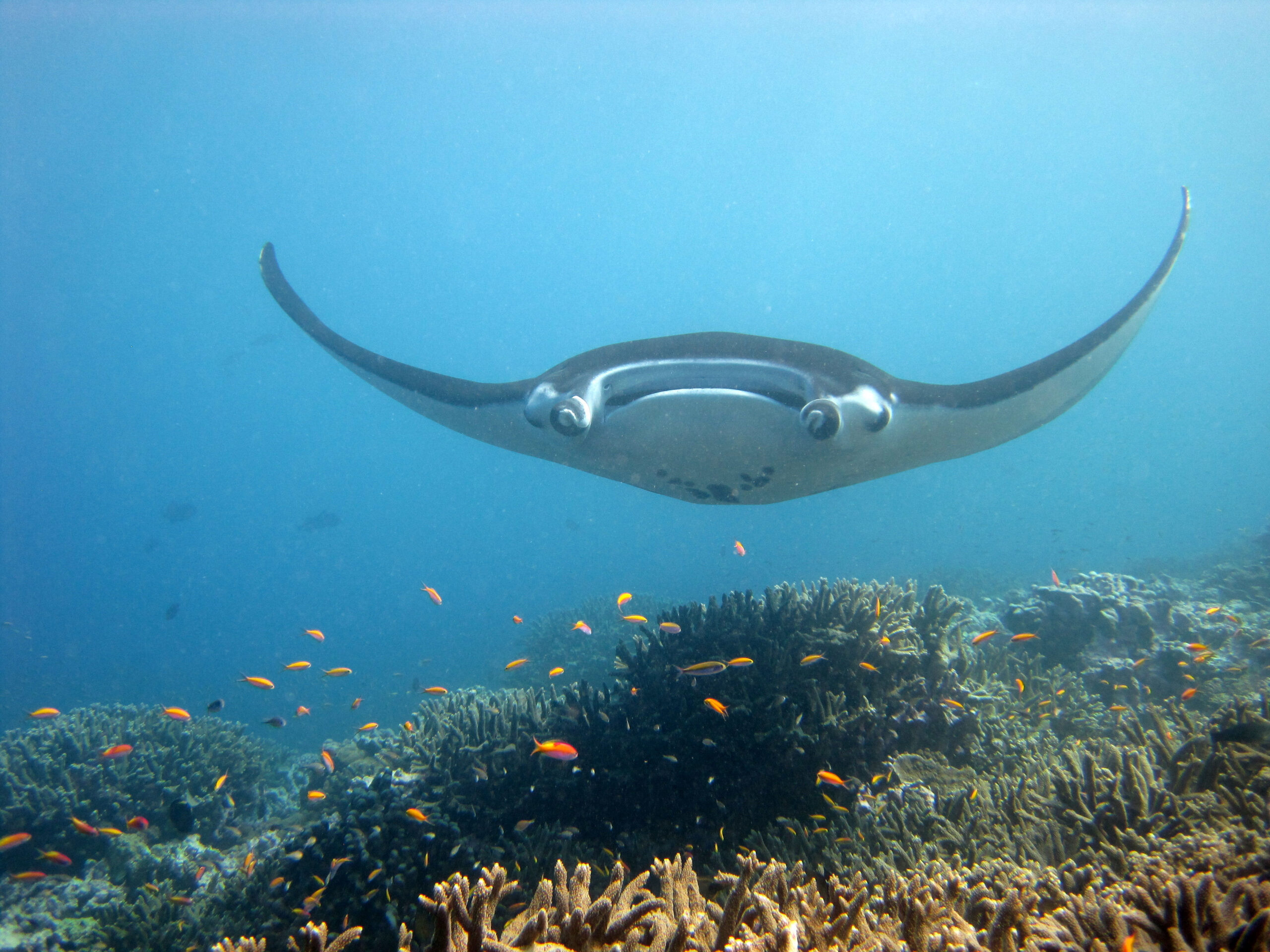
Both barrel-roll and cyclone feeding allow manta rays to minimize the costs of foraging while maximizing energy intake, especially in an unpredictable environment. The primary objective is to remain within these dense patches for as long as possible, which, unlike many other foraging strategies, doesn’t rely on speed. With each rotation, whether looping or spiraling, mantas are able to repeatedly pass through the same plankton-rich water. At the same time, these movements allow manta rays to exploit their specialized filtration system that enables microscopic prey (zooplankton) to be retained without clogging filtration surfaces. Interestingly, manta rays have inspired a variety of engineering efforts, from filtration systems modeled after these non-clogging filtration surfaces to bio-inspired underwater robots that mimic their efficient swimming.
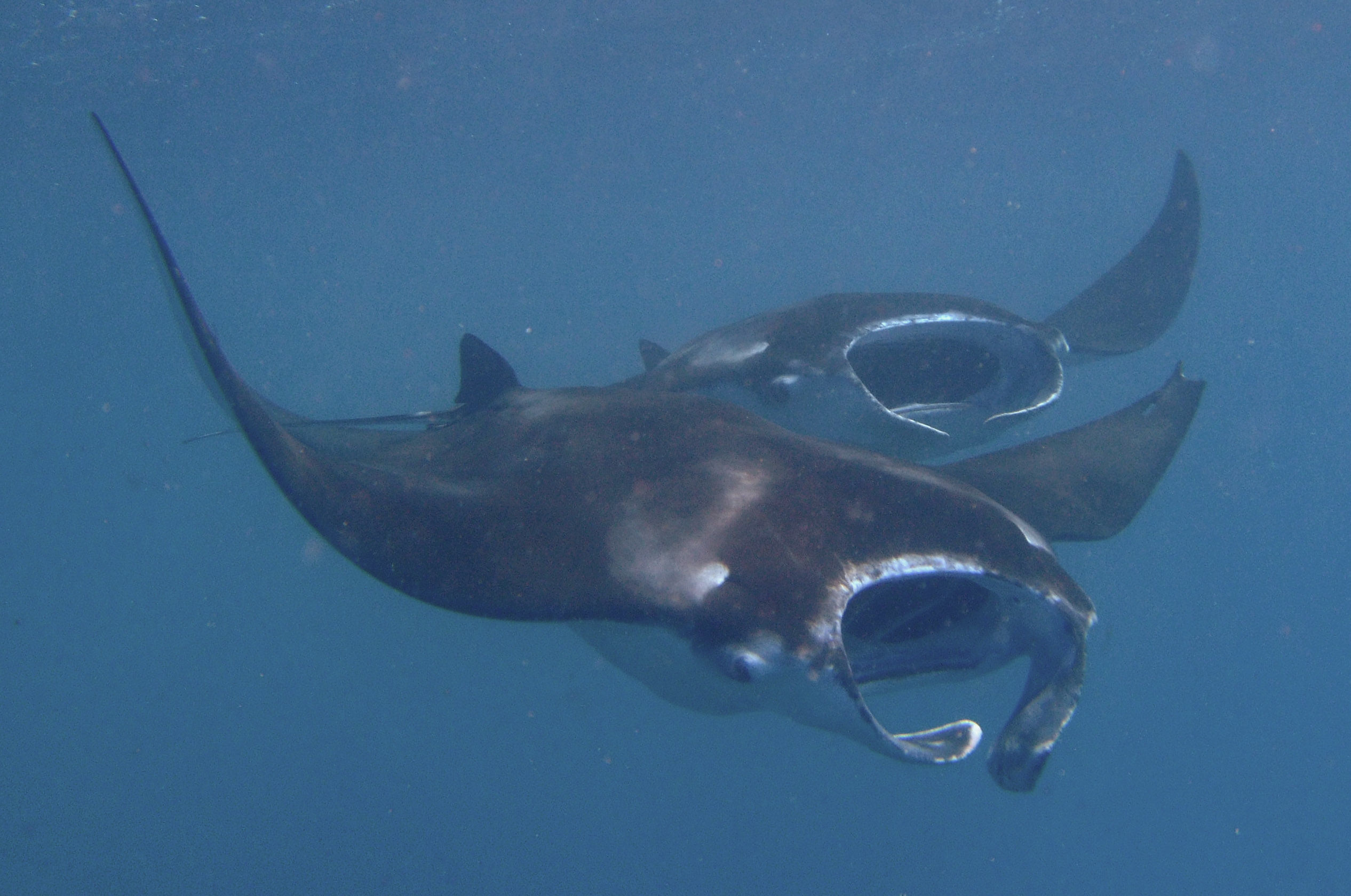
Ultimately, manta rays demonstrate that successful feeding in the open ocean is not always about speed or force, but efficiency. By using these spiral-based strategies, mantas are able to take full advantage of dense plankton blooms while conserving energy. These behaviors demonstrate how this mesmerizing motion functions as a highly effective strategy for feeding on microscopic prey in the open ocean.
Featured Image: A giant manta ray (Manta birostris) gliding through the waters near Baker Island in the Pacific Remote Islands (Image from NOAA)