
What are polymetallic nodules?
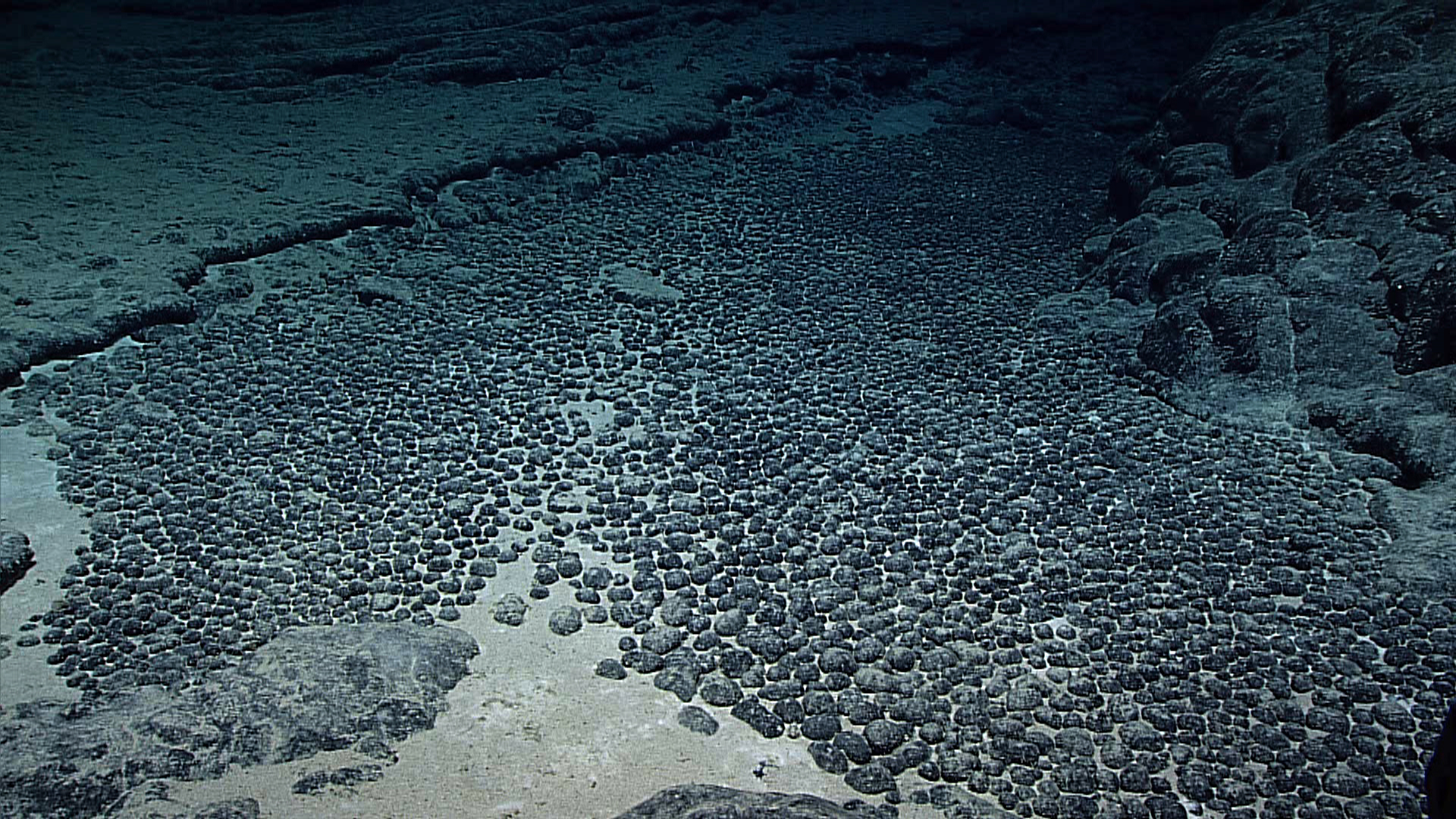
Polymetallic nodules are a newfound hot spot for economists around the globe at the moment, why? These nodules are about the size of a potato and coat the seafloor of the abyssal plane for miles. What’s special about them is that they hold a large amount of important rare earth minerals all collected in one area. Most notably iron, copper, cobalt, and of course manganese which gives them the equivalent name of “manganese nodules. Areas that have a large amount of manganese nodules have been considered by nations around the globe for deep-sea mining, including the Clarion-Clipperton Zone in the Pacific Ocean which is a big contender at the moment.
What are the benefits of deep-sea mining?
Metals such as copper, nickel, cobalt, and manganese are important for making many different technological devices. Their rarity means that the production of these devices is limited to the amount of these metals we can extract, which becomes an issue when the demand for new technology only grows. Metal extraction companies are interested in deep-sea mining as an alternative to terrestrial mining. Lots of money is getting invested into the research and machinery in order to make this happen. One of the challenges for these companies is the lack of efficient technology to extract these minerals. Deep-sea mining would give investors incentive to put more money towards deep-sea exploration and the different vehicles and technology to help do so. This has been a hurdle for many researchers trying to explore the deep sea for decades. It’s hard as it is to get sufficient funding to research the deep sea as the equipment to do so is very expensive or not yet viable. Other benefits include the easement of extraction from terrestrial land which has already taken a big toll from mining operations. It would also ease geopolitical tensions from countries relying on others for resources, as well as stimulating the economy of these countries.

What are the negative effects of deep-sea mining
Naturally the deep sea is a relatively stable environment with lots of unique inhabitants. The crawlers and other equipment that would be used to dig up these rocks will disturb the sea floor for hundreds of kilometers, uplifting large plums of debris with them. These particles will bombard the water column and travel miles along the connected ocean currents bringing dissolved particles and freed heavy metals. These metals can be toxic to the nearby fish if inhaled, while the nutrients dug up from the dredging can bring possible future harmful algae blooms closer to the shore. The increasing turbidity wont only affect the deep sea, but also areas further up the water column in the photic zone causing issues for organisms who rely on light for photosynthesis as light penetration levels decrease. The decrease in primary production will disrupt local food chains from the bottom up. On top of that, polymetallic nodules are a habitat to a variety of species including rare species only found on in certain areas. When studied, it was found that the Clarion-Clipperton Zone has thousands of faunae that are unique to this environment, many of which are newly found species to science. There is already such little information on deep-sea fauna, and with human activity interfering with the local ecology, these ecosystems likely never return to the way they were before; therefore, we would never be able to fully learn about these organisms in their natural environment. Some of these organisms have only ever been found in the Clarion-Clipperton Zone and we’d be destroying their habitat, endangering them before we get the chance to learn much about them. The impacts of mining on the seafloor will take ages to undo, if they aren’t already irreversible. There are also a number of other effects, such as release of CO2 into the atmosphere, noise pollution, loss of endangered species, and so forth. The list goes on.
Will it happen anyways?
In the end, there are already many countries all over the world who have expressed interest the mining of the sea floor. Agreements have been signed, and companies are already being made with the purpose of benefitting off of these metals. There is an organization made under the 1982 UNCLOS agreement called the International Seabed Authority (ISA), whose purpose is to regulate and come up with policies in regard to the deep sea and mining operations. If there is indeed no way to stop these companies from dredging up the polymetallic nodules, then the next best course of action would be to research the best ways to minimize possible damage done to these environments and regulate these activities the best we can. This could include advocating for policies to protect organisms on the seafloor and their habitats, advocating for the rights of endangered species, pushing for the reduce and reuse of technology parts. Or even possibly researching better ways to recycle metals and parts so there is less of a need for new raw materials. Of course, deep-sea mining events haven’t started yet so there is still a chance to fight for the best possible outcome.
Cover Image: Photo Library: Search | National Oceanic and Atmospheric Administration “A covering of manganese nodules in a bathymetric low point…”