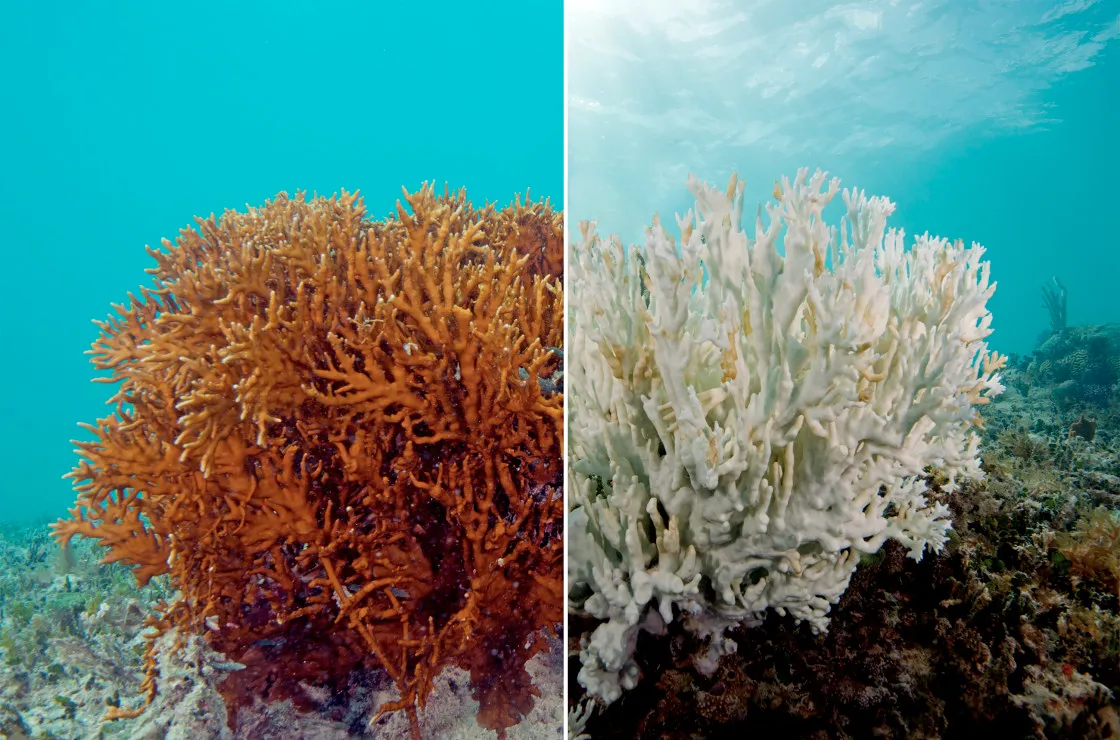
Image credit: XL Catlin Seaview Survey, via Vox (2017).
Coral reefs are among the most biologically diverse ecosystems on the planet, often compared to tropical rainforests for their complexity and productivity. These ecosystems support thousands of marine species, protect coastlines, and provided food and income for millions of people worldwide. However, in recent decades, reefs have faced a growing threat from coral bleaching, a stress response that reflects the increasing pressure placed on marine environments. As global temperatures rise and environmental stressors accumulate, bleaching events are becoming more frequent and severe, making coral bleaching one of the most urgent issues in marine biology today (Hughes et al., 2017).
What is Coral Bleaching?
When zooxanthellae, the ymbiotic algae that reside inside corals tissues and supply the majority of their energy through photosynthesis, are expelled, coral bleaching takes place. These algae also give corals their vibrant colors. Under normal conditions, the coral-zooxanthellae relationship is mutually beneficial; however, even a slight rise in sea surface temperature can disrupt this delicate balance. When temperatures exceed long-term averages by as little as 1-2°C, corals experience physiological stress, causing them to lose their zooxanthellae and turn stark white (NOAA, 2021).
Although bleached corals are not dead, the loss of algae drastically reduces their energy intake and makes them more vulnerable to disease, reduced growth, and mortality if stressful conditions persist (Hughes et al., 2018).
Why is Bleaching Increasing?
The primary driver of mass coral bleaching events is climate-driven ocean warming. According to global monitoring data, marine heatwaves have increased significantly in frequency and intensity due to rising greenhouse gas emissions (NOAA Coral Reef Watch, 2023). During prolonged heatwaves, large stretches of reef can bleach simultaneously, sometimes across entire ocean basins. The 2016 and 2017 bleaching events on the Great Barrier Reef, for example, were unprecedented in scale and occured only a year apart – leaving little time for recovery between disturbances (Hughes et al., 2017).
Local stressors add another layer of vulnerability. Nutrient pollution, sedimentation, overfishing, and coastal development reduce coral resilience and limit their ability to withstand or recover from bleaching. These combined pressures mean that even corals that survive a bleaching event may struggle to regain their previous health and energy reserves (van Oppen et al., 2015).
Consequences for Marine Ecosystems
Coral bleaching has cascading effects on entire marine ecosystems. When corals die, the three-dimensional structure of the reef begins to break down, reducing habitat complexity and eliminating shelter for fish and invertebrates. This can lead to declines in biodiversity, fisheries productivity, and ecosystem stability (Hughes et al., 2018). For human communites, the impacts are equally significant. Coral reefs contribute billions of dollars annually to tourism, fisheries, and costal protection. The loss of reefs in regions that rely heavily on reef-based fisheries. As bleaching events become more common, these ecological and economic risks will continue to grow.
How Can We Help Coral Reefs Recover?
Although global climate action is essential for long-term reef survival, there are several strategies that can boost local resillience and support recovery:
- Reducing greenhouse gas emissions to slow ocean warming and reduce the frequency of heatways (Hughes et al., 2017).
- Protecting herbivorous fish, such as parrotfish, which prevent algae from overwhelming weakned corals.
- Creating marine protected areas that reduce local stresors and give reefs space to recover.
- Coral gardening and reef restoration, where fragments of healthy corals are grown in nurseries and transplated onto degraded reefs
- Assisted evolution, a scientific approach that focuses on breeding or selecting heat-tolerant coral genotypes to create more resilient reef populations (van Oppen et al., 2015).
Although none of these strategies can fully counteract the effects of climate change, they offer valuable tools to support reef ecosystems and improve their chances of surviving future bleaching events.
Conclusion
Coral bleaching is more than a loss of color; it is a clear indicator of ecological decline and a warning sign for the health of our oceans. As climate change acceleterates, protecting coral reefs requires both global action and local conservation efforts. By understanding the causes and consequences of bleaching – and by investing in solutions that combine science, restoration, and environmental stewardship – we can help safeguard coral reefs and the vibrant marine communities that depend on them. The future of these ecosystems depends on the choices we make today.
References
Building coral reef resilience through assisted evolution, Proc. Natl. Acad. Sci. U.S.A. 112 (8) 2307-2313, https://doi.org/10.1073/pnas.1422301112 (2015).
Hughes, T., Kerry, J., Álvarez-Noriega, M. et al. Global warming and recurrent mass bleaching of corals. Nature 543, 373–377 (2017). https://doi.org/10.1038/nature21707
Hughes, T., Barnes, M., Bellwood, D. et al. Coral reefs in the Anthropocene. Nature 546, 82–90 (2017). https://doi.org/10.1038/nature22901
What is coral bleaching? (n.d.). https://oceanservice.noaa.gov/facts/coral_bleach.html
Watch, N. C. R. (n.d.). NOAA Coral Reef Watch homepage and near Real-Time products portal. https://coralreefwatch.noaa.gov/
XL Catlin Seaview Survey. (2017). Coral bleaching comparison. In Vox: Catastrophic coral bleaching is hitting the Great Barrier Reef again. https://www.vox.com/science-and-health/2017/4/18/15272634/catastrophic-coral-bleaching-great-barrier-reef-map